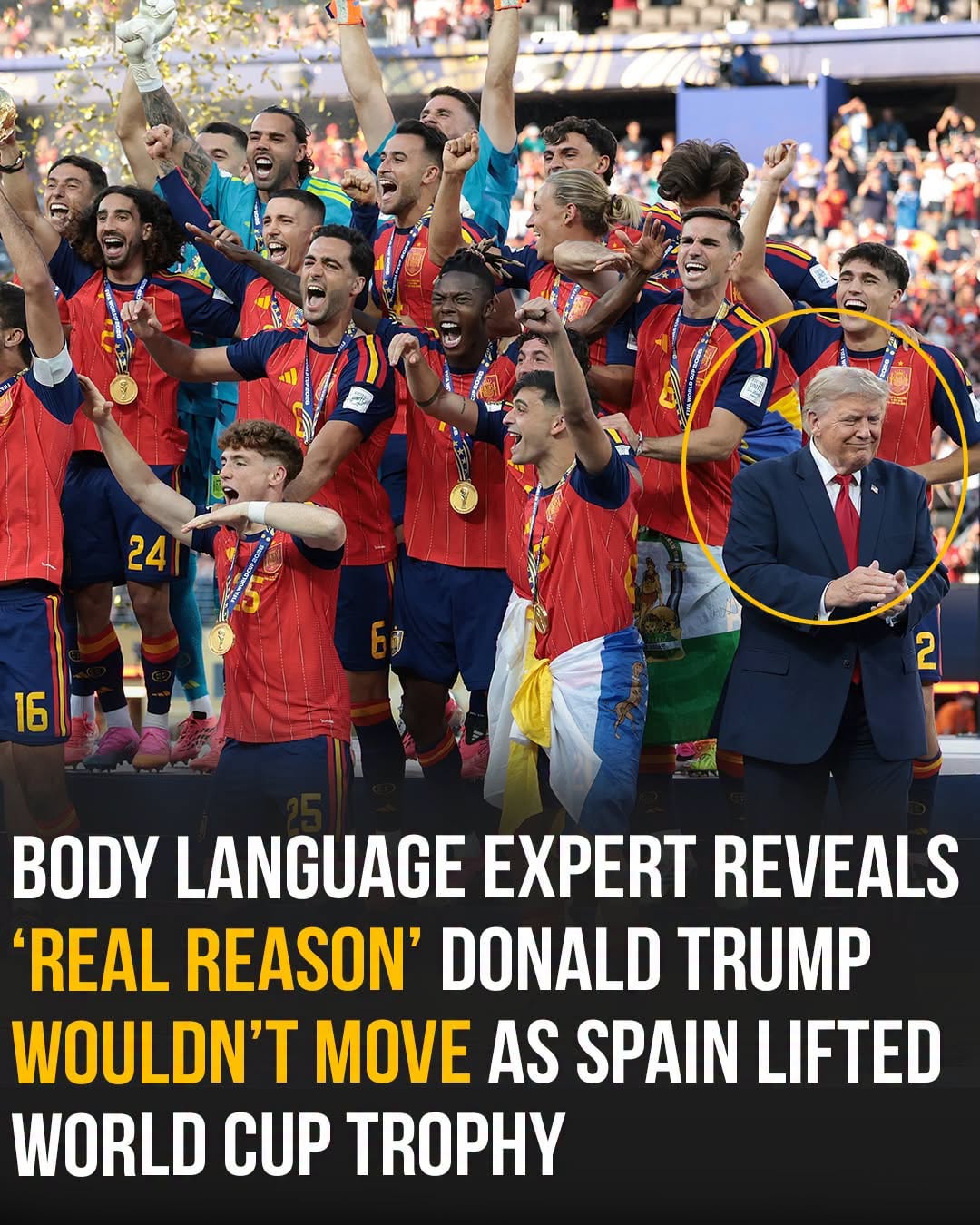
The World Cup final was supposed to create one unforgettable image: the champions lifting football’s greatest prize above their heads while the world watched.
For Spain’s players, the moment represented years of sacrifice, pressure, and determination. After the final whistle, nothing else mattered except celebrating the achievement they had worked their entire careers to reach.
But as cameras captured the trophy presentation, attention shifted toward another figure standing nearby.
Donald Trump’s presence during the ceremony quickly became one of the most discussed moments of the night, with viewers analyzing his every movement, expression, and interaction on the podium.
Among those studying the scene was body language expert Mark Bowden, who offered his interpretation of what he believed Trump’s behavior communicated during the historic celebration.
According to Bowden’s analysis, the former president’s body language suggested an effort to maintain visibility and importance during a moment that was naturally centered around the players and FIFA officials.
The ceremony itself created a complicated dynamic.
At the center of the stage were Spain’s footballers, celebrating the biggest achievement of their sporting lives. Around them stood FIFA officials, including president Gianni Infantino, who traditionally plays a central role in presenting the trophy.
Trump, meanwhile, was positioned among the most recognizable figures in the scene.
To millions watching around the world, the ceremony appeared simple.
Players received medals.
Officials offered congratulations.
The trophy was presented.
But body language specialists often argue that moments like these reveal subtle signals about confidence, status, and relationships.
Bowden focused on the differences between how players interacted with Infantino and how they interacted with Trump.
When Spain’s players approached Infantino, many appeared relaxed, smiling, and comfortable. Their body language suggested familiarity with the traditional football ceremony and the person representing the sport’s governing organization.
Their interactions with Trump appeared shorter and more formal.
According to Bowden, the contrast created a visible difference in energy between the two sides of the podium.
He suggested that the players naturally gravitated toward the person most connected to the football world, while Trump appeared to be navigating a moment where he was not the central figure.
The analysis quickly gained attention because public figures are often judged not only by their words but also by how they position themselves in important moments.
Every gesture, handshake, and facial expression can become part of the larger public conversation.
One of the key moments examined was Trump’s interaction with players during the presentation.
Handshakes involving Trump have often attracted attention in the past because of his distinctive style, which some observers have described as unusually forceful or prolonged.
However, Bowden noted that during this ceremony, Trump’s handshake style appeared more controlled.
Rather than creating a dramatic physical exchange, he seemed to maintain a more neutral approach.
The expert interpreted this as a possible adjustment to the environment.
The stage was not a political rally or business event.
It was a sporting celebration where the attention belonged primarily to athletes.
The trophy presentation created another moment of discussion.
When Spain lifted the World Cup trophy, cameras captured Trump and Infantino both reaching toward the prize.
Bowden suggested that the timing of the movement was significant, arguing that appearing alongside the FIFA president during that defining image maintained a sense of shared importance.
To supporters of this interpretation, the moment reflected a familiar pattern seen with many high-profile figures: the desire to remain connected to historic events as they unfold.
However, others viewed the situation differently.
Some observers argued that the ceremony naturally involved multiple officials and dignitaries, and that Trump’s position near the trophy was simply part of the planned presentation.
They suggested that reading deeper meaning into every movement can sometimes create narratives that may not reflect reality.
Without direct comments from Trump, FIFA officials, or the players themselves, interpretations remain opinions rather than confirmed explanations.
Still, the discussion highlights how modern sporting events have become much more than athletic competitions.
They are global spectacles watched by billions, where politics, celebrity, and culture often intersect.
A single photograph can become a worldwide talking point.
A brief handshake can dominate headlines.
A few seconds of body language can generate endless debate.
The final moments of the ceremony demonstrated exactly that.
As Spain’s players gathered around the trophy, cameras searched for the perfect image that would define their victory.
The traditional celebration unfolded: teammates surrounding the cup, smiles across their faces, confetti filling the air, and a nation celebrating a historic accomplishment.
Yet alongside those images came another conversation about presence, attention, and symbolism.
Some viewers believed Trump’s positioning reflected an attempt to remain part of the spotlight.
Others saw nothing unusual in his involvement.
Both interpretations became part of the broader debate surrounding the ceremony.
What cannot be disputed is the emotional power of the moment itself.
For Spain, the trophy represented the reward for years of preparation and belief.
For the players, that stage was about one thing: becoming champions.
The conversations surrounding the podium did not change the result or diminish the achievement.
But they showed something fascinating about the modern world.
People no longer analyze only what public figures say.
They study where they stand.
How they move.
Who they acknowledge.
Who they look toward.
In an era dominated by cameras and instant social media reactions, body language has become its own form of communication.
Whether Trump’s actions reflected strategy, habit, or simply the circumstances of a crowded ceremony, the moment captured global attention because it involved far more than football.
It was a meeting point between sport, politics, personality, and perception.
And as the confetti settled and Spain’s players celebrated their victory, one thing became clear: the World Cup final produced not only a champion on the field, but also a debate that continued long after the trophy was lifted.