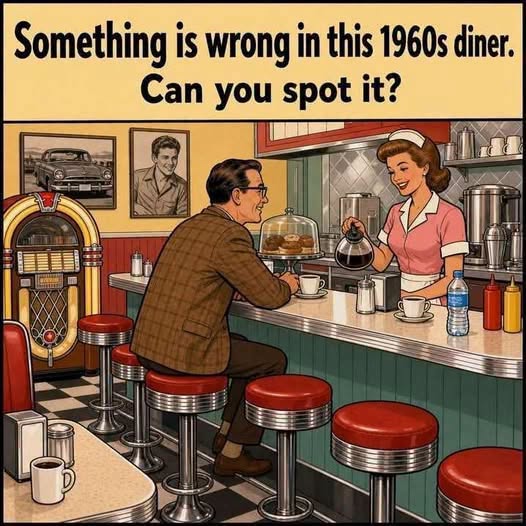
At first glance, the picture feels like a perfect time capsule. The black-and-white checkered floor. The polished counter. The warm glow of a classic diner interior. The waitress dressed in a traditional uniform. The steaming coffee sitting beside a customer’s meal. Every detail seems carefully arranged to transport you back to the golden age of American diners, a time of jukeboxes, milkshakes, and late-night conversations under neon lights.
Everything looks right.
Or does it?
Hidden somewhere inside this ordinary-looking scene is one small detail that completely breaks the illusion. It is the kind of mistake that seems obvious once someone points it out, yet somehow remains invisible to most people staring directly at the image.
That is what makes this puzzle so fascinating.
The challenge is not simply about having good eyesight. It is about understanding how the human brain works and why we sometimes fail to notice things that are sitting right in front of us.
The scene is designed to feel familiar. It uses objects, colors, and surroundings that match what we expect from a 1960s diner. Because of that, our brains immediately switch into recognition mode. Instead of carefully analyzing every object, we quickly decide, “Yes, this looks correct.”
And once our brain reaches that conclusion, it begins protecting that assumption.
The strange thing is that our minds are not always trying to see reality exactly as it is. They are constantly trying to save energy. They fill in missing information, overlook small inconsistencies, and focus on what seems important.
That ability helps us move through everyday life faster.
But in a hidden-object puzzle, it becomes our biggest weakness.
The diner appears to tell a familiar story. A waitress serving customers. A quiet afternoon meal. A classic restaurant from decades ago. Your brain recognizes the pattern and stops searching for anything unusual.
Then comes the surprise.
A modern plastic water bottle appears in the middle of the vintage setting.
That single object changes everything.
The bottle immediately feels out of place because it belongs to a much newer era. While bottled water existed in limited forms before, the common plastic bottles people recognize today were not part of everyday life in the 1960s. Seeing one sitting casually on a diner table breaks the historical illusion instantly.
It is not the size of the object that makes it difficult to find.
It is the fact that your brain does not expect it to be there.
When we look at an image, we often search for what we believe should exist rather than carefully examining what actually exists. If a scene contains a diner counter, coffee cups, old furniture, and vintage clothing, we accept the entire picture as authentic. We are not naturally looking for something modern because our expectations tell us the environment is already correct.
This is why optical puzzles and visual challenges are so popular. They reveal something surprisingly deep about human perception.
We like to believe that we observe everything around us.
In reality, we observe only a fraction.
Every day, our brains filter enormous amounts of information. They decide what deserves attention and what can be ignored. Without this ability, simple tasks would become overwhelming. Imagine having to consciously process every sound, color, movement, and object around you every second.
The brain’s filtering system keeps us functioning.
But sometimes it also hides things from us.
The diner puzzle is a perfect example.
People often stare at the image for several seconds, sometimes even minutes, searching for the mistake. They examine the waitress, the furniture, the food, and the decorations. They look for something dramatic a missing object, a strange body position, or a major historical error.
But the answer is much smaller.
It is something ordinary.
And that is exactly why it works.
The best hidden details are often not things that look strange. They are things that look normal but do not belong.
A smartphone in an ancient painting.
A modern road sign in a historical photograph.
A digital clock in a medieval castle.
A plastic bottle in a 1960s diner.
These mistakes succeed because they blend into the environment instead of standing apart from it.
There is also something nostalgic about this type of puzzle. Scenes like this remind people of a slower era, when diners were gathering places rather than just quick stops for food. Families shared meals. Travelers rested at roadside restaurants. Servers knew regular customers by name. The atmosphere represented comfort, routine, and connection.
That emotional connection makes the brain even more willing to accept the scene.
When something feels familiar, we trust it.
The hidden bottle becomes almost invisible because the rest of the image creates such a strong sense of authenticity.
This simple challenge teaches a surprisingly valuable lesson.
Seeing is not the same as noticing.
We can look directly at something and still fail to truly recognize it. Our assumptions, memories, and expectations influence what we perceive. Sometimes the biggest mistakes are not hidden because they are complicated they are hidden because we never thought to question them.
That is why puzzles like this are more than just entertainment.
They remind us to slow down.
They encourage us to look again.
They challenge the automatic conclusions we make every day.
In a world filled with information, advertisements, images, and constant distractions, the ability to pay attention has become more important than ever. A small visual mistake in a diner scene may seem insignificant, but it represents a much bigger truth about how we experience life.
We often see what we expect to see.
We often notice what we are prepared to notice.
And sometimes, the smallest details are the ones that reveal the biggest surprises.
The next time you look at an old photograph, walk through a familiar street, or scroll past an image online, remember this diner puzzle.
The thing you are searching for may not be hidden at all.
It may be sitting right in front of you, waiting for you to finally stop assuming and start looking.