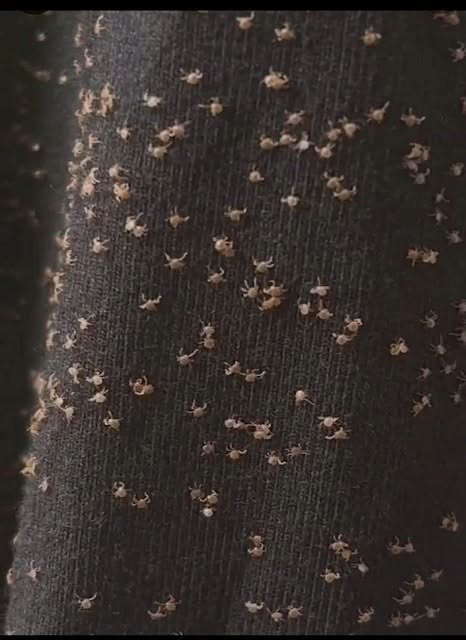
At first, it looked like something strange had followed me home.
After a quiet walk through a grassy trail, I noticed dozens of tiny objects covering my pant leg. They were scattered across the fabric like miniature pieces of nature that had somehow attached themselves without my noticing. My first reaction was confusion, followed quickly by a little concern.
What were these things?
Had something crawled onto me?
Was it some kind of insect?
Was I carrying something I definitely did not want to bring inside?
The answer was much more fascinating than frightening.
Those tiny objects were not unwanted creatures or signs of a problem. They were seeds—small, perfectly designed travelers created by plants that depend on movement to survive. They were burrs and seed pods, nature’s clever way of turning animals, clothing, and anything else that passes by into a temporary transportation system.
What seemed like a random inconvenience was actually a brilliant example of natural engineering happening quietly all around us.
Most people walk through fields, forests, and overgrown paths without thinking about what is happening beneath their feet. We notice the scenery, the trees, the flowers, and the sounds of birds, but we rarely pay attention to the small details that reveal how connected everything truly is.
Those tiny burrs tell a hidden story.
They are not designed to stay where they grow.
Plants cannot walk.
They cannot chase sunlight, search for new soil, or carry their seeds across large distances by themselves. Instead, many species developed creative solutions. Some use wind. Some rely on water. Others use animals as living transportation.
Burrs belong to this last group.
Their tiny hooks, spikes, or rough surfaces allow them to attach to fur, feathers, and even fabric. A passing animal brushes against the plant, the seeds hold on, and the traveler unknowingly carries them somewhere new.
Eventually, the seed falls away, lands in fresh ground, and begins the next stage of its life.
The plant has successfully expanded its reach without moving an inch.
It is a strategy so simple that it is easy to miss, yet so effective that it has existed for thousands of years.
The most surprising part is how little we notice these interactions.
I did not feel the seeds attaching to my clothing.
I did not see the moment they jumped from the plant to my leg.
There was no dramatic event announcing that something had happened.
One moment, I was simply walking.
The next moment, I was carrying evidence of an invisible process that had been unfolding around me the entire time.
That realization changes the way you see ordinary walks.
A simple path through tall grass is no longer just a path. It becomes a place filled with tiny exchanges and hidden movements. Every breeze, every insect, every animal, and every plant is part of a larger system working quietly in the background.
The burrs on my pants were a reminder that nature does not need to be loud to be impressive.
Some of the most extraordinary designs are the ones we barely notice.
People often imagine innovation as something created in laboratories or technology companies. But nature has been solving complex problems for millions of years. Seed dispersal is one of those solutions.
A small plant needed a way to move its offspring away from competition.
The answer was not complicated machinery.
It was a tiny hook.
A simple structure.
A clever relationship between plants and passing creatures.
The more you look at the natural world, the more examples you find of this kind of intelligence.
Flowers attract pollinators with color and scent.
Some seeds float across oceans.
Others explode from pods and launch themselves into the surrounding area.
Some cling to animals and wait for a new destination.
Every strategy reflects adaptation and survival.
The little objects stuck to my pants represented a journey that had already begun long before I noticed them. The plant had created them. The environment had carried them. My walk had become part of the process.
Instead of being annoyed, I found myself appreciating the design behind it.
Of course, there is still the practical side.
Anyone who has spent time outdoors knows burrs can be frustrating. Removing dozens of tiny seeds from clothing can take patience. They can become tangled in shoelaces, stuck in pet fur, or attached to blankets and backpacks.
But even that inconvenience is proof of how well they work.
A successful design is one that achieves its purpose.
And burrs achieve theirs perfectly.
They are meant to grab on.
They are meant to travel.
They are meant to make themselves impossible to ignore.
The next time you find strange little pieces of nature attached to your clothes after spending time outside, it may be worth looking closer before brushing them away.
What appears to be a nuisance might actually be a tiny masterpiece of survival.
Those little hooks are not random.
They are not accidental.
They are the result of countless generations of adaptation, shaped by the simple need to continue growing.
A walk through the grass may seem like a quiet, ordinary moment, but the natural world is always working around us.
Seeds are searching for new places.
Plants are planning their futures.
Life is constantly moving in ways we rarely see.
Sometimes all it takes is a few tiny things stuck to your pant leg to remind you that the world is far more fascinating than it first appears.
What followed me home that day was not a problem.
It was a lesson.
A small piece of nature’s creativity, quietly hitching a ride and proving that even the smallest details can carry an incredible story.