There are certain places in a city that seem to exist outside of time, where days blur into nights and the rhythm of life is measured not by clocks but by machines, steady, indifferent machines that beep and hum without ever pausing to consider the people tethered to them.
St Gabriel s Medical Center was one of those places. If you walked its corridors long enough, especially after midnight when foot traffic thinned and conversations dropped into whispers, you would begin to notice how the air itself felt heavier, as though it carried the weight of unfinished stories. It was where people came to heal, yes, but also where some quietly prepared to leave, often without the world noticing.
In room 417, at the far end of a hallway that nurses jokingly referred to as the quiet stretch, twelve year old Noah Whitaker had learned to read that silence better than anyone. He understood what the hushed tones meant, the way doctors avoided direct answers, the way his mother smiled just a little too quickly whenever he asked a question that edged too close to the truth. Noah was not naive. He had stopped being naive somewhere between his third round of treatments and the moment he overheard two specialists discussing quality of life just outside his door. But he was also not ready to surrender to the idea that this was all there was left.
His body had changed in ways he barely recognized anymore. His arms were thinner, his energy unpredictable, and even simple movements required more effort than they should have for someone his age. Yet his mind, stubborn and curious, kept reaching outward, clinging to the fragments of the world he had not experienced yet. And of all the things he imagined, places he had not been, moments he had not lived, there was one that returned again and again, vivid and insistent. Motorcycles.
It had started with a sound, weeks earlier, when a group of riders passed by the hospital late one evening. The deep, rolling thunder of their engines had cut through the sterile quiet like something alive, something untamed, and Noah had sat up in bed despite the ache in his chest, drawn to it in a way he could not quite explain. He had pressed his hand against the cool glass of the window, watching as the headlights streaked past like fleeting stars, and for a brief moment, he had imagined himself out there. Moving. Not confined. Not measured by machines or charts or whispered conversations.
Since then, the idea had taken root. Mom, he had asked one afternoon, his voice soft but steady, what does it feel like to ride one of those. Evelyn Whitaker, who had spent the better part of the past year mastering the art of answering impossible questions, paused just long enough to gather herself before replying. I think it feels like freedom, she said, choosing the word carefully, as though testing whether it could hold the weight of what he was really asking. Noah had nodded, turning that word over in his mind. Freedom. It sounded like something distant, something reserved for people who still had time to chase it. I want to know, he had said after a moment, not looking at her. Just once. She had reached for his hand then, squeezing it gently, but she had not answered. Because what answer could she give. That he could not. That it was not safe. That the world outside those walls was no longer something he could simply step into. Every response felt like a betrayal, not just of his wish, but of the small, stubborn hope he still carried. So she said nothing. And sometimes, silence says more than words ever could.
The night everything shifted began with a storm that seemed to arrive without warning, rolling over the city in thick, dark waves. Rain lashed against the windows, wind rattled the frames, and somewhere in the distance, thunder cracked sharply enough to make even the most seasoned staff glance up from their routines. It was the kind of night that made the world feel smaller, more contained, as though everything beyond those walls had been temporarily erased. Inside room 417, Noah lay awake, staring at the ceiling, listening to the familiar cadence of the machines beside him. Sleep had become unpredictable, often slipping just out of reach when he needed it most, and tonight was no exception. His thoughts drifted, circling the same questions, the same quiet realizations he rarely spoke aloud.
Then, through the storm, he heard something. At first, it was faint, almost indistinguishable from the rumble of thunder. But as he focused, it became clearer. Deeper. More rhythmic. Engines. Not one. Many. Noah sat up, ignoring the protest in his muscles. He turned toward the window, his heart picking up in a way that had nothing to do with fear. Mom, he whispered. Evelyn, who had been dozing lightly in the chair beside his bed, stirred. What is it, sweetheart. Listen. She held still, her breath catching as the sound grew louder, more distinct. It was not just passing traffic. It was something deliberate, something approaching.
Together, they looked toward the window. Through the curtain of rain, a line of headlights emerged, cutting through the darkness with quiet determination. One by one, motorcycles pulled into the hospital parking lot, their engines idling in a low, steady chorus that seemed almost surreal against the backdrop of the storm. Evelyn s first instinct was confusion, quickly followed by something sharper, concern, maybe even fear. This was not normal. This was not planned. But Noah was already moving. He swung his legs over the side of the bed, wincing but determined. I want to see, he said. Before she could stop him, he was walking toward the door.
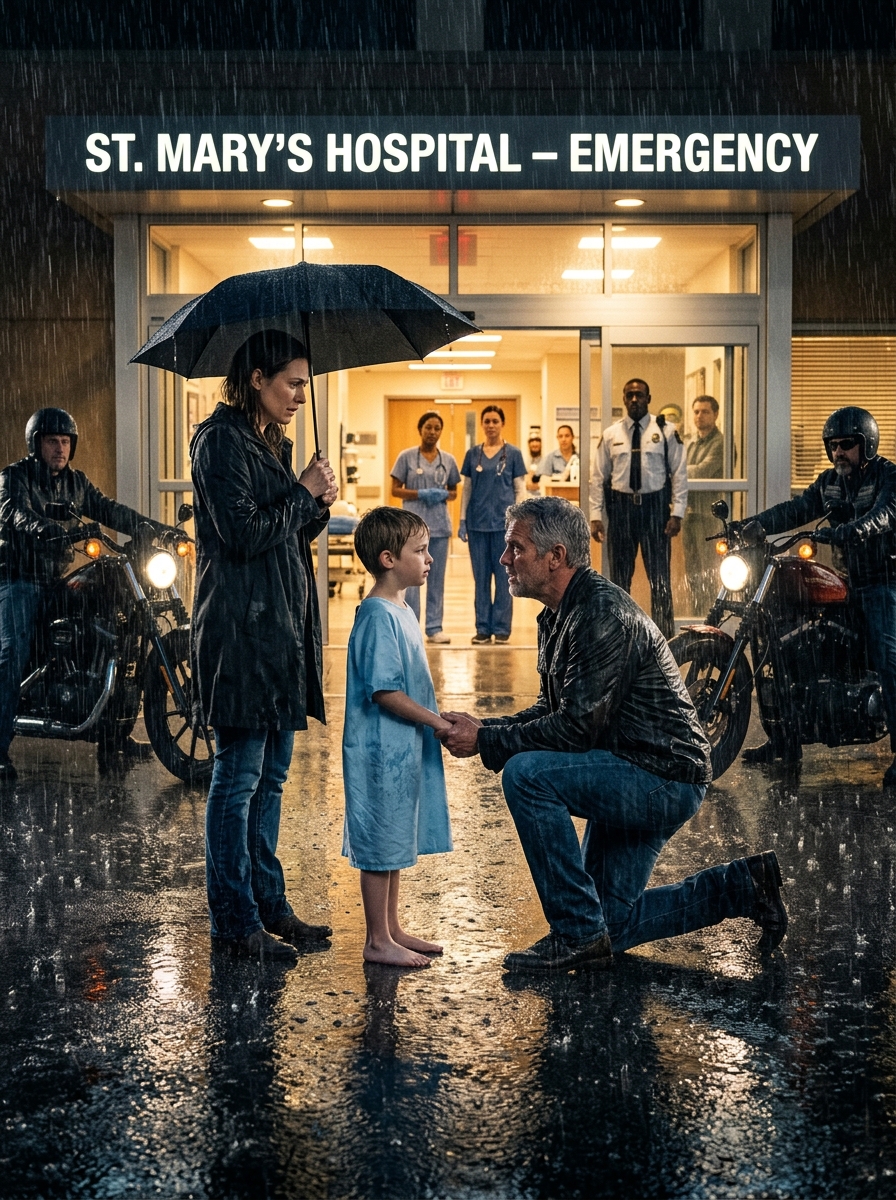
The hallway erupted into motion as soon as Noah stepped out. Nurses called after him. Alarms were triggered. Footsteps echoed against the polished floors as staff tried to intercept him, but he moved with a kind of urgency that surprised everyone. It was not that he was fast. His body would not allow that. But he was determined, and sometimes determination carries you further than strength ever could. By the time he reached the main entrance, the automatic doors slid open, revealing the storm in full force and beyond it, the riders. There were at least a dozen of them, their bikes lined up in a loose formation, headlights casting long reflections across the rain slick pavement.
At the center stood a man who seemed to command attention without trying. His name was Ronan Blake. He was older than most of the others, his beard streaked with gray, his posture relaxed but grounded in a way that suggested experience rather than intimidation. He was not smiling, but there was nothing cold about his expression either, just a quiet awareness, as though he was taking in more than he let on. When Noah stepped out into the rain, Ronan s gaze shifted immediately to him. For a brief moment, everything else seemed to fall away. The storm. The noise. The tension from the hospital staff gathering behind them.
Are you the kid who likes motorcycles, Ronan asked, his voice steady, carrying just enough to be heard over the rain. Noah nodded, water already soaking through his thin shirt, though he did not seem to notice. I have never been on one, he said. Ronan studied him for a second longer, then glanced at Evelyn. That true. She hesitated, then nodded. There was a pause, not long, but long enough for the weight of the situation to settle in. Hospital staff hovered at the doorway, unsure how to intervene. Security exchanged uncertain looks. No one quite knew what to do.
Ronan crouched slightly, bringing himself closer to Noah s level. Why tonight, he asked. Noah swallowed, glancing briefly at his mother before answering. Because I do not know how many nights I have left. The honesty of it cut through everything. Ronan exhaled, a slow, measured breath, then stood again. He looked at Evelyn, really looked at her this time, as if asking a question he would not voice out loud. She met his gaze. And for a moment, there was an understanding there that did not need words. An acknowledgment of what this was, what it meant, and what it might cost.
Just keep him safe, she said finally, though even as she spoke, she knew safe was not the point anymore. Ronan nodded once. That, I can try, he said. One of the bikes was rolled forward. Ronan handed Noah a helmet, adjusting it carefully, making sure it sat right despite the boy s thinner frame. You hold on to me, he said. Not the bike. Me. Got it. Noah nodded, his hands trembling slightly as he reached forward. When the engine roared to life, it sent a vibration through both of them, deep and immediate. Noah gasped, not in fear, but in something closer to awe. And then, before anyone could fully process what was happening, they moved.
The bike surged forward, cutting through the rain, followed by the others in a loose formation that felt less like a convoy and more like a silent agreement to witness something important. For Noah, the world transformed instantly. The hospital disappeared, replaced by motion, by wind, by the raw sensation of being part of something larger than himself. He laughed, a sound so pure, so unrestrained, that it seemed to echo even over the engines. And for those few minutes, nothing else existed. Not the diagnosis. Not the timelines. Not the quiet, looming end everyone had been trying not to name. Just the ride.
When they returned, everything felt different, though no one could quite explain why. Noah was exhausted, his energy spent in a way that was both obvious and oddly peaceful, but his smile remained, lingering even as Ronan helped him down from the bike. Was it, Ronan started, unsure how to finish the question. Noah nodded before he could. Yeah, he said softly. It was. Inside the hospital, chaos waited. Administrators already discussing liability. Staff scrambling to document what had just happened. But outside, in that small, rain soaked space, there was only a quiet understanding that something meaningful had taken place. Noah returned to his room shortly after, his body giving in to the exhaustion, but his expression remained calm, almost content.
Two days later, he passed away. Peacefully. Evelyn was with him, holding his hand, just as she had been from the beginning. The story, however, did not end there. What Ronan had done, what all of them had done, did not stay contained within that parking lot. Someone had recorded part of it, a short video capturing the moment Noah s laughter broke through the storm, and by the next morning, it had spread across the city, then beyond. At first, the reactions were divided. There were those who condemned it, citing rules, safety, protocol. But there were just as many, if not more, who saw something else entirely. They saw a boy who had been given a moment of genuine joy when he needed it most. They saw a group of strangers who had chosen compassion over caution, humanity over procedure.
Slowly, the conversation shifted. Hospitals began reevaluating how they handled end of life care, introducing programs that focused not just on comfort, but on meaningful experiences. Community groups organized events for children in similar situations, offering them chances to do the things they had always dreamed of but never thought possible. As for Ronan, he did not seek attention. He paid the fines, answered the questions, and went back to his life much the same as before. But something had changed, even if he did not talk about it. A few weeks later, he received a letter. Inside was a photograph. Noah, helmet slightly oversized, hands gripping the handlebars, his smile wide and unguarded. There was a note, written in careful handwriting. You did not save his life. But you gave him something just as important. You reminded him what it felt like to live. Thank you. Ronan read it more than once, then folded it carefully, slipping it into the inner pocket of his jacket. And for the first time in a long while, he allowed himself a small, quiet smile. Not because he had done something extraordinary, but because, in a moment that mattered, he had chosen to do what was right.