Some funerals unfold exactly as people expect. Orderly. Contained. Grief kept carefully within invisible boundaries.
Others fracture something open, exposing not just loss but everything that had been quietly buried alongside it. The morning Arthur Halstead was laid to rest was supposed to belong to the first kind. The programs had been printed, the eulogies rehearsed in hushed living rooms, and the cemetery staff had already prepared the plot at the far end of Crestwood Hill. It should have been simple. A respectable man, a grieving wife, a circle of acquaintances ready to say goodbye. Instead, by the time the rain finally eased that afternoon, no one present could say with certainty who Arthur Halstead really was or what exactly they had just witnessed.
The rain had started before sunrise, steady and unrelenting, turning gravel paths into slick ribbons of mud and forcing people to huddle beneath black umbrellas. By ten o clock, the sky had settled into a dull gray that drained the world of color. People spoke in low voices, exchanging polite condolences that followed familiar patterns. He was a good man. Gone too soon. At least he did not suffer long. Phrases that sounded sincere but rarely ventured beyond the surface of what anyone actually knew. Arthur had been, by all outward appearances, a respectable figure in the community. He ran a financial advisory firm, served on local boards, and had a reputation that suggested reliability more than warmth. Not beloved, but trusted. His sudden cardiac arrest had caught people off guard mostly because it disrupted that sense of order.
At the center stood his wife, Elise Halstead. She wore black, but it was not the color that drew attention. It was the way she carried herself within it. Precision. Stillness. A careful composure that felt almost rehearsed, as if she had decided in advance exactly how grief should look. Her face remained composed, her eyes dry despite the rain collecting along her lashes. When people approached to offer condolences, she responded with polite nods and brief, measured phrases. Some interpreted it as strength. Others found it unsettling.
Near the back, partially obscured by taller attendees, stood a woman who did not belong. She wore a dark wool coat that had seen better days, its fabric darkened by rain. She carried no umbrella, made no attempt to shield herself from the weather or from curious glances. Her name was Mara Ellison. And she had not come to say goodbye. She stood with her hands in her pockets, her gaze fixed on the coffin, as if everything else existed at a distance she had no interest in crossing.
At the front, Reverend Cole spoke of legacy, of the way a person s life ripples outward through the people they touch. His voice was steady, practiced, appropriate. But as he spoke, Elise s attention shifted. Her gaze locked onto Mara. Recognition hit her face like a physical blow, followed by something darker, something that had been held in check for too long and now refused to remain contained. Elise stepped forward, her heels sinking into the softened ground. You, she said, her voice cutting through the rain. I knew you would show up.
Mara did not move. Rain traced down her face. I was not sure I would, she replied quietly. But he asked me to. Elise let out a short, humorless laugh. Of course he did. You should not be here. You do not get to stand there like you are part of this. Mara s gaze did not waver. I never said I was. Then leave, Elise snapped. Before you make this worse.
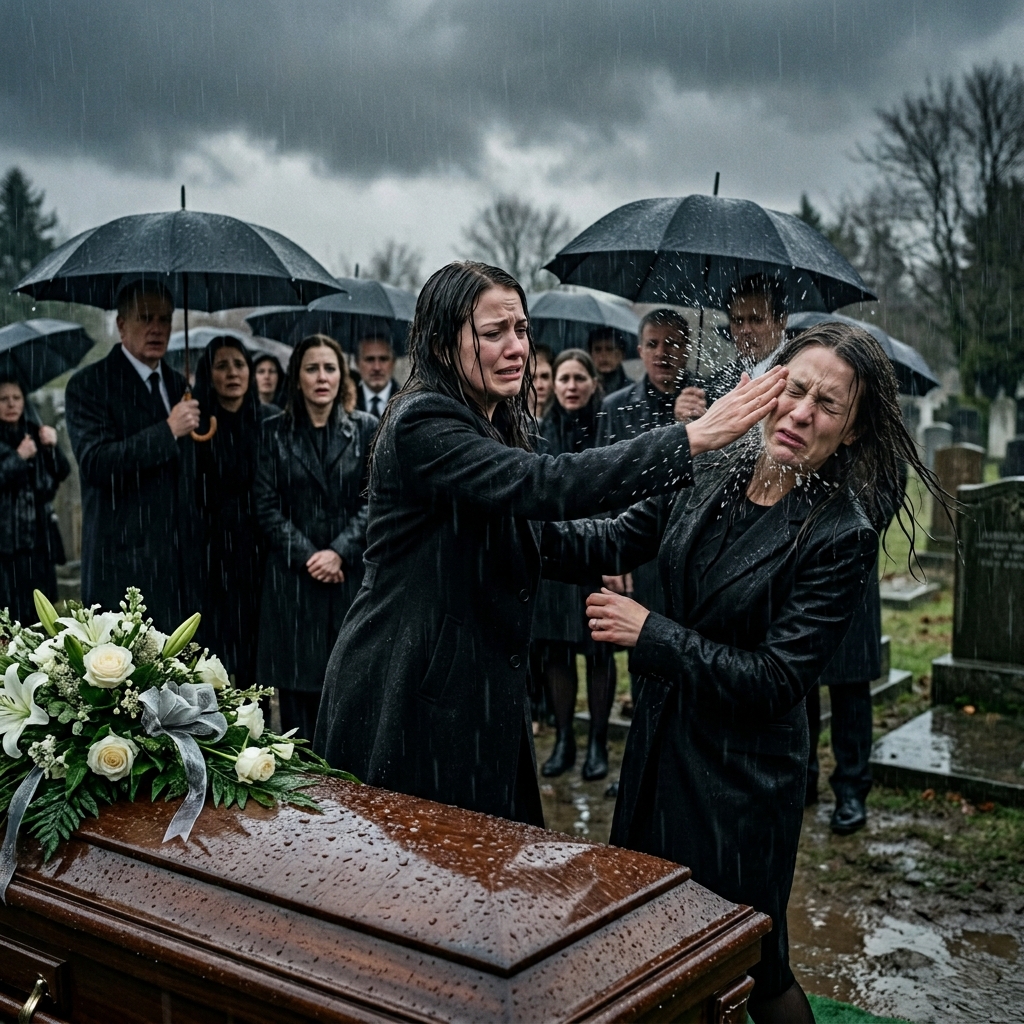
For a moment, it seemed like Mara might comply. Instead, she stepped forward. I think it already is, she said. That was the moment everything broke. Elise s hand moved before most people realized what was happening. The crack of skin against skin echoed against the muted backdrop of rain. Mara stumbled, her hip colliding with the polished wood of the coffin with a hollow thud that reverberated through the crowd. Gasps erupted. Someone dropped a bouquet. You do not get to pretend you mattered, Elise shouted. You do not get to stand here like you knew him better than I did.
Mara steadied herself, one hand resting briefly against the coffin. When she turned back, her expression had not hardened. There was only quiet sadness. I am not pretending, she said softly. But Elise was not listening anymore. Mara reached into her coat pocket. The movement was small but drew every eye. When her hand emerged, it held a ring. Gold. Worn. Simple but unmistakably old. Without a word, she stepped closer to the coffin and released it. The sound it made against the wood was soft, a faint metallic clink, but in the charged silence that followed, it might as well have been thunder.
Reverend Cole stepped forward and picked up the ring. As he turned it in his fingers, his expression shifted. What is this, he murmured. Elise crossed her arms. It is nothing. A cheap trick. But the reverend held the ring closer, squinting at the faint engraving along the inner band. A H and L M, Always, 1998. The initials did not match Elise Halstead. A ripple of unease spread through the group. L M, someone whispered. Who is that. Elise s face drained of color. Mara spoke before anyone else could. Lena Marlowe, she said quietly. That ring was buried with her. The tension sharpened because this was no longer about an unknown woman at a funeral. It was about something that had been buried, intentionally, and was now somehow back.
Elise shook her head too quickly. That is impossible. He did not think so, Mara replied. How do you know that, Reverend Cole asked, his voice unsteady. Mara hesitated just long enough to make the moment stretch. Because I was there, she said. At the end. A flicker of panic crossed Elise s face. He did not die at home, Mara continued, her tone still calm but heavier now. Not like you told everyone. He was in a private hospice facility outside the city. He did not want people to see him like that. He asked me to stay with him during the nights. And you expect us to believe that, Elise snapped, though her voice lacked its earlier certainty. Mara met her gaze. I do not expect anything, she said. I am just telling you what he could not.
Piece by piece, Mara explained how Arthur, in his final weeks, had become consumed by irregularities in old records, discrepancies that pointed to a grave being opened years after Lena had been buried. He started asking questions, quietly at first. But the more he looked, the less it added up. Elise s breathing became uneven. He found out the ring was missing long before he met you, Mara continued. And he never understood why. Stop, Elise whispered. But Mara did not. He thought maybe it had been stolen. Then he found the paperwork. Signatures that did not match. Dates that overlapped in ways they should not. And one name that kept appearing.
She did not say it immediately. She did not need to. Everyone was already looking at Elise. I did not mean to hurt him, Elise said suddenly, her voice breaking. I just could not live in her shadow anymore. I was always compared to her. Always second. Always the replacement. I just wanted something that was mine. The ring, Mara asked gently. Elise nodded, tears finally cutting through her composure. It was stupid. I know that now. But at the time, it felt like taking something back. Mara s expression softened. He forgave you, she said. Elise looked up, startled. What. He did not want to expose you, Mara explained. He did not want to destroy what you had. He just wanted the truth to exist somewhere outside his own head. That is why he gave me the ring. He said if it stayed buried, then none of it meant anything. Not the forgiveness. Not the life you built together. It would all be just another lie.
The weight of that settled heavily over the group. As the burial resumed, no one spoke. Not because there was nothing left to say, but because everything that mattered had already been revealed. Mara turned and walked away, her figure disappearing through the thinning rain. Behind her, Elise remained, her shoulders no longer rigid, her grief no longer controlled. Long after the funeral ended, the moment people remembered was not the slap or the confrontation. It was the sound of that small gold ring striking wood. A quiet, undeniable reminder that truth, no matter how deeply buried, has a way of finding its way back to the surface.