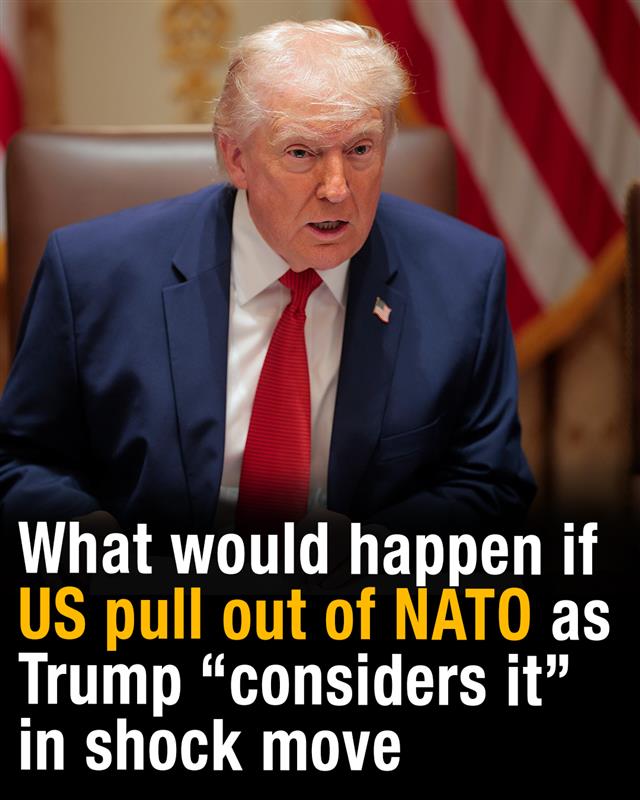
If the United States ever truly walked away from NATO, the shock would ripple far beyond Brussels or Washington. Every security guarantee, every military plan, every quiet understanding built since 1949 would be thrown into doubt overnight.
The alliance was founded on a simple promise that has deterred aggression for generations. An attack on one member is an attack on all. Remove the United States from that equation, and the math changes completely. What was once unthinkable becomes terrifyingly possible.
Rivals would test the edges of this new world immediately. Within weeks, perhaps days, hostile powers would begin probing where American power ends and hesitation begins. They might move against a Baltic state, calculating that Europe alone lacks the military weight to respond effectively. They might pressure a non NATO ally, sensing that Washington s attention is elsewhere. They might simply rattle sabers, watching to see who flinches first. The message would be clear. The old rules no longer apply. And in international politics, when rules disappear, chaos rushes in to fill the void.
Allies, suddenly unsure, would react with a mixture of panic and pragmatism. Some might race to rearm, suddenly aware that they can no longer rely on the American security umbrella. Germany might reconsider its post Cold War military restraint. Poland might accelerate its defense buildup. France, which has long advocated for European strategic autonomy, might finally get its wish, though not under the circumstances it hoped for. Others might cut their own deals with rival powers, seeking protection from whoever is willing to provide it. Turkey, already an unpredictable partner, could realign further with Russia. Hungary might follow suit. The unity that has defined the West for decades would fracture along unpredictable lines.
Still others might drift toward competing blocs entirely. China would watch closely. Beijing has long sought to challenge the post World War II order without triggering a direct confrontation with the United States. A US withdrawal from NATO would be a gift. It would demonstrate that America is no longer willing to bear the burdens of global leadership. It would encourage Chinese expansion in the South China Sea, in Central Asia, and beyond. It would make it easier for Beijing to peel away European allies who feel abandoned by Washington. Russia would be more aggressive still. Vladimir Putin has spent his entire political career trying to break the unity of the West. A US withdrawal would be his greatest victory.
At home, the damage would be deeper than strategy papers can show. A formal exit might be blocked by law, but years of open threats could still poison trust, making NATO s mutual defense promise feel fragile just when it is needed most. The president does not have unilateral authority to withdraw from a treaty ratified by the Senate. Congress could fight back. Courts could intervene. But the damage would be done before any legal challenge was resolved. Allies would have heard the threat. Adversaries would have noted the division. The perception of American unreliability would take root, and perceptions in international politics are often more powerful than facts.
The United States would remain strong, but more isolated. Forced to spend more, risk more, and stand more often alone. The military would still be the most powerful in the world. The economy would still be the largest. But power without allies is like a fortress without gates. It can hold for a while, but eventually, isolation takes its toll. Intelligence sharing would suffer. Logistics would become more complicated. Diplomatic support would evaporate. Every crisis would require the US to act unilaterally, bearing the full cost and the full risk.
In that lonely space, even a superpower can discover its limits. Not the limits of its weapons or its wealth, but the limits of its influence. Influence is not just about what you can do to others. It is about what you can convince others to do with you. Without allies, the United States would still be able to bomb its enemies. But it would struggle to build coalitions, to impose sanctions, to shape international norms. The tools of leadership, the soft power that has amplified American strength for generations, would be severely blunted.
The economic consequences would be severe as well. NATO is not just a military alliance. It is a framework for cooperation that has facilitated trade, intelligence sharing, and diplomatic coordination for decades. Pulling out would send a signal to global markets that the United States is retreating from its role as the guarantor of international stability. Investors hate uncertainty. The stock market would tumble. The dollar might weaken. Rivals would seek to fill the vacuum, offering their own security arrangements that come with their own strings attached.
The nuclear question would become urgent. NATO s nuclear sharing arrangements are built around American warheads stationed on European soil. If the United States leaves, those warheads would likely leave as well. Some European nations might seek their own nuclear arsenals. Germany, Poland, or Turkey could decide that the only reliable deterrent is a homegrown one. Nuclear proliferation, long contained, would accelerate. The world would become more dangerous, and the United States would be partly responsible.
Military planners would scramble. The US military has spent decades integrating its forces with NATO allies. Withdrawal would mean untangling thousands of agreements, closing bases, repositioning troops, and rethinking every contingency plan. The cost would be staggering, not just in dollars but in capability. The US military would still be the strongest in the world, but it would be operating without the forward positioning and allied cooperation that makes it so effective. Every operation would be harder. Every deployment would be slower. Every conflict would be riskier.
The political fallout at home would be intense. Supporters of withdrawal would argue that Europe has freeloaded off American protection for too long. Critics would warn that the president is dismantling the very alliances that kept the peace for three generations. The debate would be bitter and divisive, further fracturing an already polarized nation. Foreign policy would become a partisan battleground, making it even harder to build consensus on international engagement. The world would watch, and the world would worry. Not just about America s enemies, but about America itself.
In the end, the damage might be irreparable. NATO could survive without the United States, but it would be a shadow of its former self. European nations would try to hold the alliance together, but without American leadership, it would lack the military weight and political cohesion to deter major aggression. The post Cold War peace, already fraying, might finally shatter. And the world would look back at the decision to leave as the moment everything changed. Not with a bang, but with a withdrawal. Quiet. Deliberate. And catastrophic. The United States would remain strong, but it would be strong alone. And in a world of rising rivals, alone is a dangerous place to be.