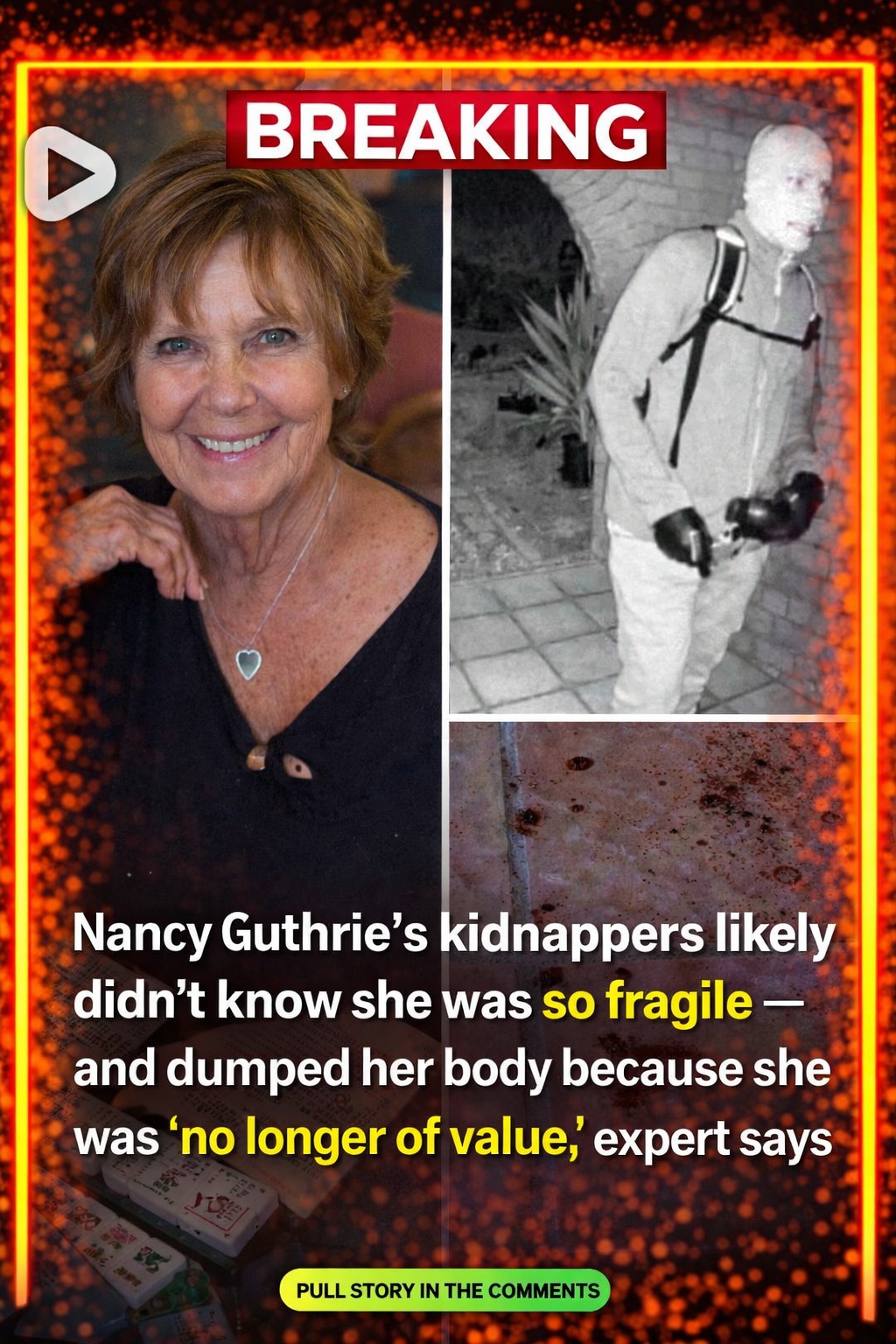
Detective Brian Martin s theory is brutally simple. Whoever took 84 year old Nancy Guthrie thought they had stumbled upon an easy payday.
They allegedly stormed her Tucson home in the dark, ignoring the blood at the door and the reality of her fragile medical condition. Heart problems. High blood pressure. A pacemaker keeping time for a body that had already survived decades of ordinary wear and tear. None of that mattered to the people who snatched her from her bed. They saw dollar signs. They did not see a vulnerable elderly woman who could not withstand the ordeal they were about to put her through.
When her fragile body could no longer keep up, the plan, Martin believes, shifted. Ransom became disposal. The original goal was money. Demand cash in exchange for her safe return. That is how kidnappings are supposed to work. But Nancy Guthrie was not a healthy hostage. She was not young or resilient. The stress of being taken, the fear, the uncertainty, the physical toll of being moved against her will. All of it pressed down on a system that was already struggling. At some point, her body gave out. And when it did, she stopped being valuable.
Dead, she was no longer of value to them. That is the cold arithmetic of the kind of criminals Martin has spent his career studying. They do not think in terms of humanity or morality. They think in terms of assets and liabilities. A living hostage is an asset. A dead one is a liability. The longer a body remains undiscovered, the harder it becomes to trace back to the people who left it. So they find a place. Remote. Isolated. Somewhere no one goes looking. And they walk away, hoping the earth will do the rest.
For Savannah Guthrie, the Today show co anchor who has begged for answers, that possibility is almost unthinkable. She has spent weeks pleading through the media, asking anyone with information to come forward. She has described her mother as a kind, gentle woman who loved her family and never hurt anyone. The idea that Nancy spent her final moments terrified, alone, and ultimately discarded like garbage is too much to hold. But it fits the silence that has followed. Sixty seven days. No calls. No credible ransom demand. No trace. Nothing but questions and the slow erosion of hope.
Investigators still insist this is a kidnapping. They use the official language of an active investigation. They have not declared Nancy dead. They have not named suspects. They have not closed the case. But Martin s experience tells him something else. He has worked similar cases for decades. He knows the patterns. The first forty eight hours are critical. After that, survival rates drop dramatically. After a week, hope becomes statistical. After sixty seven days, the most likely explanation is not that Nancy is being held somewhere waiting for rescue. The most likely explanation is that she is already gone, and the people who took her are the only ones who know where.
Martin believes the most important clue to what happened next is not in a phone record or a ransom note. It is not in a grainy surveillance video or a witness statement that leads nowhere. It is wherever they chose to leave her. Somewhere remote. Somewhere dark. Somewhere they hoped she would never be found. The desert around Tucson offers endless possibilities. Miles of open land, abandoned mines, dry riverbeds, canyons that have not seen human footsteps in years. A body placed carefully in such a landscape could remain hidden for decades, perhaps forever.
The theory is brutal because it makes sense. Nancy Guthrie was not a typical kidnapping target. She was not wealthy in a way that would attract professional criminals. She was not involved in anything that would make her a target for revenge or intimidation. She was simply an elderly woman living alone in a house that someone decided to break into. The blood at the door suggests violence. The pacemaker suggests vulnerability. Put them together, and a different picture emerges. Not a calculated kidnapping for ransom, but a home invasion that went wrong, followed by a desperate attempt to cover up the crime.
If Nancy died during the commission of another felony, her killers would face far more serious charges than they would for burglary or even assault. Hiding the body buys them time. It creates uncertainty. It makes it harder for prosecutors to prove what happened. Every day that passes without a discovery is a day they remain free. That is the logic Martin sees at work. Not sophisticated criminal genius. Just desperate people trying to save themselves.
Savannah Guthrie has not given up. She continues to speak publicly about her mother, keeping the case in the headlines, refusing to let Nancy become a forgotten name on a missing persons list. Her hope is that someone, somewhere, knows something and will finally come forward. But hope is a fragile thing. It frays over time. Sixty seven days is a long time to hold on.
Martin does not say any of this to be cruel. He says it because he believes the truth, no matter how painful, is better than the endless uncertainty of not knowing. Families of missing persons often describe the waiting as its own kind of torture. The not knowing. The possibility that their loved one is still out there suffering. In some ways, knowing the worst can be easier than imagining endless variations of the worst. Closure, imperfect as it is, allows grief to begin.
The search for Nancy Guthrie continues. Investigators follow leads that go nowhere. Tips pour in and are checked and discarded. The desert keeps its secrets. And somewhere out there, Detective Martin believes, Nancy is waiting to be found. Not alive. Not coming home. But waiting nonetheless. For the truth to catch up. For the people who took her to face what they have done. For a family to finally have the answers they deserve. That is not justice. Not yet. But it is the only path forward in a case that has already taken far too long to solve.