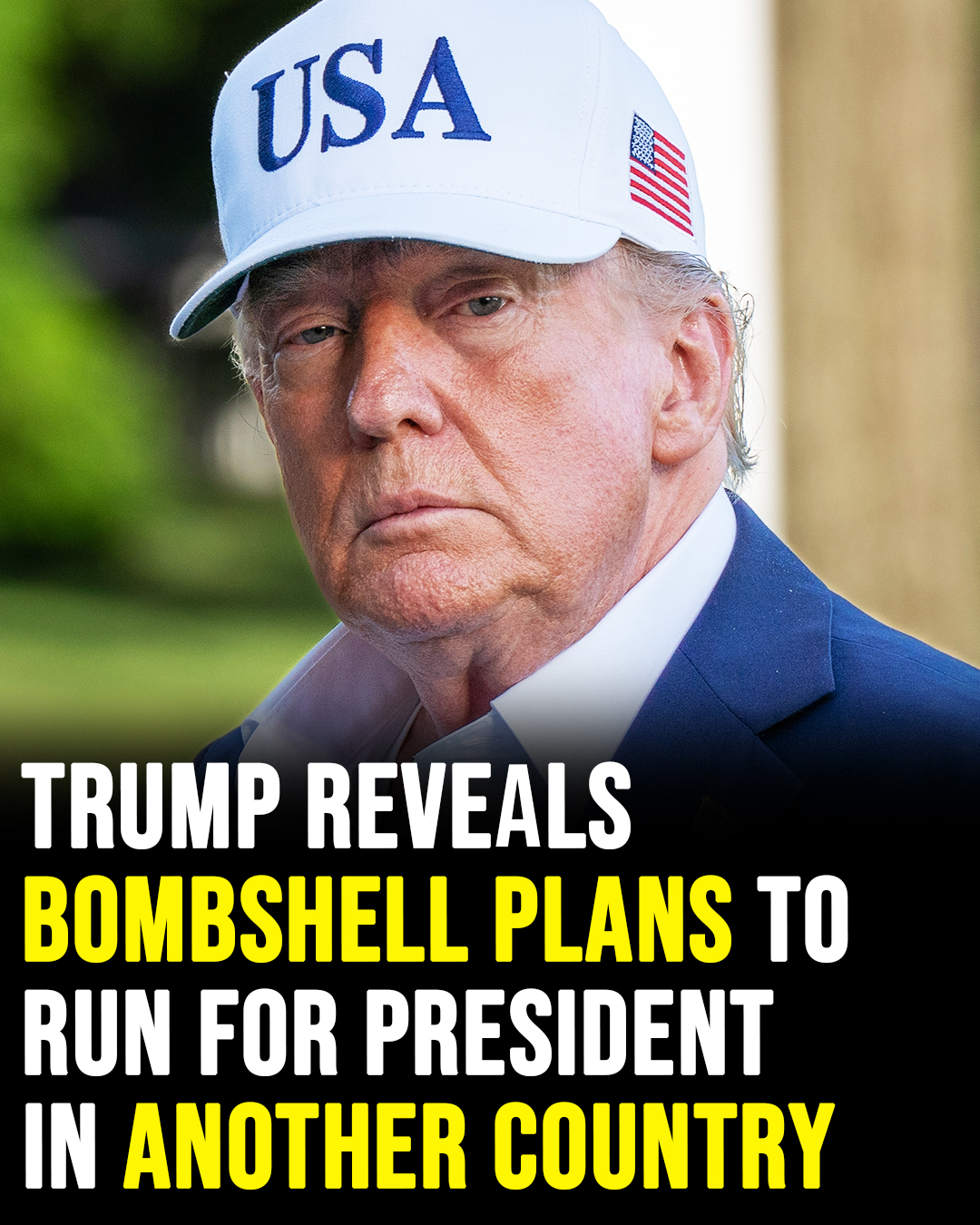
For a man constitutionally barred from a third term in the White House, the idea of exporting his presidency to a foreign nation is both surreal and deeply unsettling.
Donald Trump, never one to shy away from provocative statements, recently floated a notion that sounded at first like a joke but quickly revealed itself as something far more complicated. Speaking at a private gathering, Trump mused about running for president in Venezuela after a hypothetical US backed operation toppled Nicolás Maduro. What landed as an offhand remark carried the weight of a test balloon half bluster and half trial run for a new kind of power fantasy that exists somewhere between reality television and geopolitical chaos.
Trump boasted that Venezuelans adore him, claiming his poll numbers there are historic and that he could simply pick up a new country the way others pick up a new job. His confidence was unshaken, his delivery classic Trump: loud, grinning, and daring anyone to laugh. But within the same breath, he bragged that he would quickly learn Spanish, then immediately sneered that he would not waste time learning your damn language. That pivot exposed the familiar contempt beneath the showmanship. It was the same tactic he has used for years: first the charm, then the jab, leaving his audience unsure whether to applaud or cringe.
The idea of Trump running for president in Venezuela is absurd on its face. He is not a Venezuelan citizen, does not speak the language, and has no political infrastructure in a country he has spent years criticizing. Yet the absurdity is precisely the point. Trump understands that in the modern media landscape, the line between serious proposal and performance art has blurred beyond recognition. By floating an impossible scenario, he dominates headlines, forces reactions, and keeps his base entertained. But beneath the spectacle lies a more troubling reality when power meets ego without limits, borders start to look negotiable and democracy anywhere becomes negotiable too.
Trump’s Venezuela comments did not emerge in a vacuum. They came against a backdrop of escalating military threats against Iran, saber rattling over Greenland, and a self proclaimed Golden Age of the Middle East announced from his Truth Social platform. Each statement, taken alone, seems like another headline grabbing outburst. But together they form a pattern. Trump is testing the boundaries of what a former and potentially future president can say without consequence. He is probing how far the Overton window can shift, how much of the unthinkable can become thinkable, and how many people will simply shrug and move on.
The Venezuela remark also taps into a deeper fantasy that has long animated Trump’s political identity the idea that he is so popular, so effective, so beloved that his appeal transcends borders, cultures, and even legal constraints. In this fantasy, Trump is not merely a former American president. He is a global brand, a solution in search of problems, a man whose leadership is so universally desired that countries would beg him to take over. It is the same logic that fueled his business ventures his name on hotels, towers, and products around the world. But applying that logic to the presidency of a foreign nation is something else entirely.
Critics were quick to pounce. They called the remarks delusional, dangerous, and deeply revealing of Trump’s authoritarian instincts. Supporters, meanwhile, dismissed the comments as typical Trump humor, insisting that no one should take him literally. But the pattern of saying outrageous things and then hiding behind the claim of joking has become a familiar shield. It allows Trump to float ideas, gauge reactions, and normalize the abnormal without ever fully committing to accountability. Whether he is joking or not becomes less relevant than the fact that millions of his followers hear something they like in the chaos.
The Venezuelan people, who have suffered under Maduro’s authoritarian rule for years, deserve better than to be treated as props in a former president’s ego project. Trump’s claim that they adore him is unsubstantiated. His suggestion that a US backed operation could simply install him as a leader echoes the darkest chapters of American interventionism. It recalls a time when the United States treated Latin America as its backyard, toppling governments and installing friendly dictators with little regard for democracy or human life. That history is not something to joke about. It is a source of deep trauma for millions of people across the region.
Yet Trump’s remark was not aimed at Venezuelans. It was aimed at his American audience. For them, Venezuela is a distant country associated with crisis, inflation, and failed socialism. Trump’s proposal, absurd as it is, plays into a narrative that he alone can fix broken systems, that his strength is so overwhelming that even foreign nations would welcome him as a savior. It is a powerful story for supporters who feel that America itself has been stolen from them. If Trump can win in Venezuela, the thinking goes, why should he not have won in 2020? The logic is circular but emotionally satisfying.
The danger is that this kind of rhetoric desensitizes the public to the very idea of authoritarianism. When a former president casually discusses running a foreign country, it normalizes the notion that leaders are interchangeable, that nations are properties to be acquired, that democracy is just one option among many. It erodes the sacredness of citizenship, the rule of law, and the consent of the governed. These are not abstract principles. They are the foundations of free society. And when they are treated as punchlines, the ground beneath them begins to shake.
Trump’s words feel less like comedy and more like a warning. The same man who refused to concede an election, who encouraged a mob to march on the Capitol, who has spent years undermining faith in American institutions, is now joking about taking over another country. For those paying attention, the joke is not funny. It is a glimpse into a mind that sees power as an end in itself, unmoored from law, tradition, or morality. And as that mind inches closer to the possibility of another term, the question is no longer whether he is serious, but whether enough people will take him seriously enough to stop him.