Far beyond every human footprint, as Artemis II slipped into the dark stillness on the far side of the Moon, the mission stopped feeling like pure history and started feeling deeply human.
The spacecraft was a marvel of engineering thousands of components working in perfect harmony, years of training condensed into moments of execution, the weight of national ambition its boosters. But inside that capsule, four astronauts were not just representatives of their countries or their agencies. They were people. And people, even in the cold vacuum of space, carry their hearts with them.
A Mission That Became Personal
The crew could have celebrated distance and records. They could have focused on the science, the data, the checklists that would define their mission’s success or failure. Instead, they looked down at two untouched scars on the lunar surface and chose to fill them with meaning: one named for the vessel that carried them, and one for the woman who could not be there to see it.
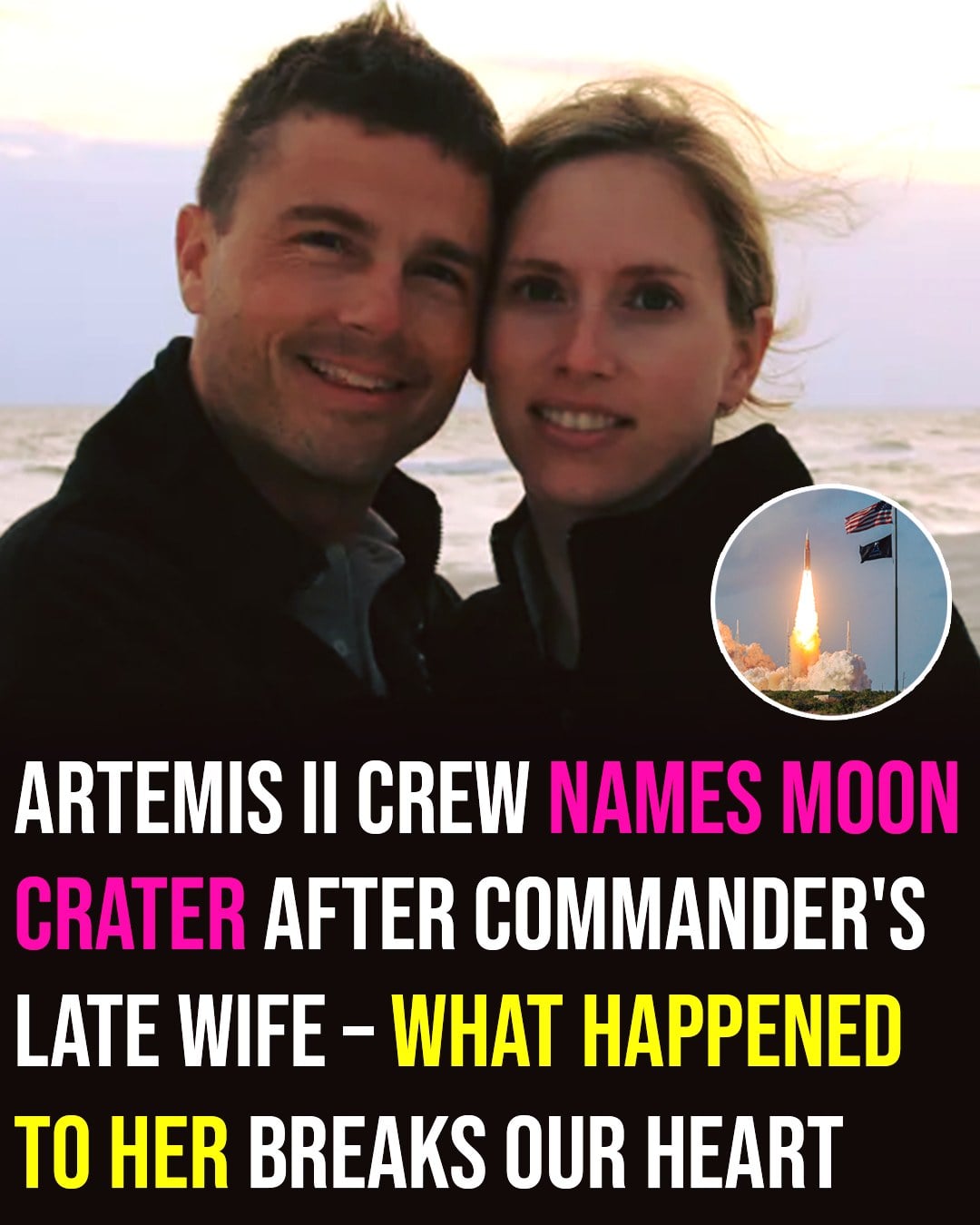
The decision was not made by committee. It was not the result of focus groups or bureaucratic approval. It came from the commander a man who had lost his wife, who had raised their daughters in the shadow of grief, who had poured his pain into training and his hope into this flight. He looked at the Moon, at the craters that had waited billions of years for names, and he saw an opportunity. Not for glory. For remembrance.
The Woman Behind the Name
Carroll was not famous. She was not a politician, an astronaut, or a public figure. She was a pediatric nurse a woman who spent her life comforting frightened families, holding tiny hands, and whispering reassurance in the darkest hours of the night. Her patients knew her as gentle. Her colleagues knew her as tireless. Her husband and daughters knew her as everything.
When she fell ill, the family rallied around her. When she passed, they thought the world had ended. But grief, as it often does, revealed hidden strengths. The commander threw himself into his work. The daughters grew closer, supporting each other through milestones their mother would never see. And slowly, painfully, they began to imagine a future without her not because they wanted to, but because she would have wanted them to.
45 Seconds of Silence
In those 45 seconds of radio silence after the proposal to name the crater, the distance between Houston and the Moon felt unbearably small. Back on Earth, mission controllers waited, unaware of the emotional weight being carried in the capsule above them. They saw telemetry data heart rates, oxygen levels, system statuses. They did not see the tears. They did not see the commander’s hands trembling slightly as he spoke. They did not see his daughters, watching from Earth, realizing that their father had found a way to keep their mother’s memory alive forever.
A pediatric nurse who spent her life comforting frightened families was being written, tentatively, into the sky. Not into textbooks or documentaries, but into the very fabric of the lunar surface. A crater that had existed for eons without a name would now carry hers. Future astronauts would walk past it. Future generations would study it. And somewhere, in the quiet of space, her name would echo.
The Meaning of Integrity
The second crater, Integrity, was named for the vessel a tribute to the engineering and teamwork that made the mission possible. But the name carried a double meaning. Integrity was also a quality the commander saw in his wife: her honesty, her moral clarity, her refusal to compromise her values even when it would have been easier to do so. In naming the crater Integrity, he was not just honoring a spacecraft. He was honoring a woman who had taught him what the word meant.
The two craters would sit side by side on the lunar surface, forever linked. Integrity and Carroll. The mission and the woman. Science and love, existing in the same space, neither diminishing the other.
Whether the Names Are Ever Approved
Whether or not the names are ever formally approved by the international bodies that govern lunar nomenclature, Integrity and Carroll already exist in the language of a grieving husband, in the quiet courage of two daughters, and in the way science sometimes pauses to bow its head. Approval is a formality. The true naming happened in that capsule, in those 45 seconds of silence, when four astronauts looked at the Moon and decided that some things matter more than history.
The international community may eventually ratify the names. They may choose different ones. But for the family, for the crew, for everyone who has ever lost someone they loved, the craters are already named. They will look up at the Moon and see Carroll. They will trace the outlines of Integrity and remember. No bureaucracy can erase that.
Science Pausing to Bow Its Head
There is something profound about the moment science pauses to acknowledge emotion. Space exploration is often framed as cold, rational, driven by data and deadlines. But the people who explore space are not robots. They carry photographs in their helmets. They write letters to their children before launch. They name craters after the women they loved and lost.
In that pause that brief suspension of mission protocols and operational efficiency something essential was affirmed. We explore not just to discover, but to remember. We reach for the stars not because they are empty, but because they are the only canvas large enough to hold our grief, our love, and our hope.
A Legacy Written in the Sky
Carroll’s legacy is no longer confined to memories or photographs. It is written on the Moon. Every time humanity looks up at that silver disk in the night sky, her name will be there not for everyone, not officially, but for those who know. Her husband will see it. Her daughters will see it. And someday, perhaps, her grandchildren will point at the Moon and say, “That crater is named after my grandmother. She was a nurse. She was kind. And she is still here.”
That is the power of naming. That is the gift the commander gave his family. Not a monument of stone or steel, but a monument of light and shadow, visible from anywhere on Earth, eternal in a way that human structures can never be.
A Final Reflection
In the end, the story of Artemis II’s crater naming is not about space exploration. It is about love. It is about loss. It is about the human need to leave behind evidence that we existed, that we mattered, that someone remembered us after we were gone.
Carroll may never have dreamed of having a crater named after her. She may never have imagined that her husband’s grief would find such an extraordinary outlet. But that is the nature of legacy: it is not something we plan. It is something others give us, out of love, when we are no longer there to receive it.
So look up at the Moon tonight. Find the dark spot that was once unnamed and now carries a story. Think of a pediatric nurse who comforted frightened families. Think of a commander who turned grief into tribute. And remember that even in the coldest, emptiest places of the universe, love finds a way to write its name.