
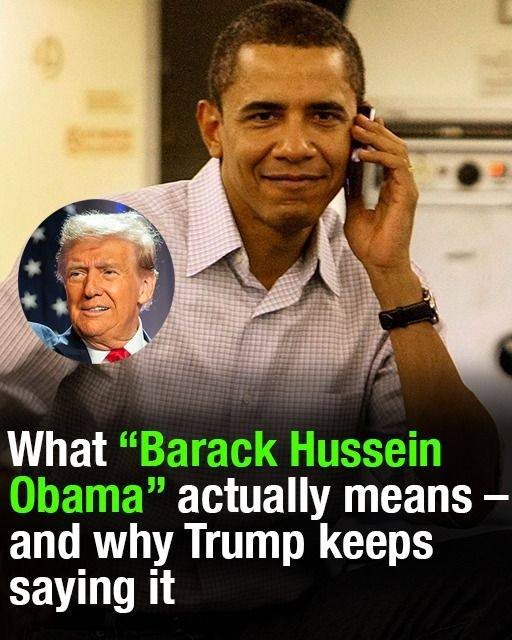
Trump’s obsession with Barack Obama’s full name was never random. From the earliest days of his political rise, he made a point of using all three names Barack Hussein Obama uttering them with a deliberate rhythm, a slight pause before “Hussein,” a tone that signaled something beyond mere identification.
Supporters heard it as a kind of exposure, as if he were revealing a hidden truth. Critics heard something darker: a dog whistle, a nod to old fears, a way of marking Obama as different, as other, as not quite American.
The Politics of a Name
Saying “Hussein” with a sneer was a shortcut to old prejudices, a way to summon Islamophobia and whisper that Obama did not truly belong. For millions of Americans who had never met a Muslim or traveled to the Middle East, the name “Hussein” carried weight it should not have. It became a symbol, a trigger, a way of suggesting secret allegiances and hidden loyalties. Never mind that Obama is a Christian. Never mind that his middle name was given by his father, a Kenyan man who was himself not particularly religious. The name alone was enough. In the fever swamps of political rhetoric, facts mattered less than feelings.
Trump understood this instinctively. He knew that repeating “Hussein” would unsettle some listeners, energize others, and keep Obama perpetually framed as an outsider. It was not about accuracy. It was about association. About tying Obama to a part of the world that many Americans had been taught to fear.
The Actual Meanings Behind the Names
Yet the actual meanings behind those names quietly refuse that script. They tell a story that could not be more different from the one Trump tried to weave.
“Barack” is tied to blessing, to being favored. In Arabic, the root word carries connotations of divine blessing, of grace, of something given freely rather than earned. It is a name that suggests abundance and generosity. Every time Trump said “Barack,” he was pronouncing a name that means, at its core, “blessed by God.”
“Hussein” is even more striking. It means goodness, beauty, and moral character. It is a name associated with integrity, with doing the right thing, with inner virtue that shines outward. The irony is almost unbearable: the name Trump weaponized as a slur actually describes the very qualities his own supporters claim to value in a leader.
Even “Obama,” rooted in his Kenyan heritage, suggests a journey that bends toward fulfillment after struggle. In the Luo language of his father’s people, the name carries echoes of resilience, of moving forward despite obstacles, of arriving at a destination that was always meant to be.
The Blessing He Could Not See
So each time Trump leaned on that name for a cheap laugh, he was, without realizing it, reciting a kind of benediction over his rival. He was saying, “Blessed one, of good character, who struggled and succeeded.” He was praising Obama in the very act of trying to diminish him. The insult turned inward, exposing far more about the speaker than the subject.
Trump’s politics has always depended on stoking fear instead of fostering understanding. Fear of immigrants. Fear of Muslims. Fear of the other, the unknown, the person who does not look or sound or worship like “us.” The name “Barack Hussein Obama” was a convenient vessel for those fears not because of anything the name actually means, but because of what Trump and his followers imagined it meant.
The Story the Name Tells
In the end, the story the name tells is not about danger or foreignness, but about grace carried through adversity and about the smallness of those who try to twist it. Obama’s journey from a childhood in Indonesia and Hawaii to the presidency of the United States is itself a testament to the meanings embedded in his name. Blessed. Good. A journey toward fulfillment.
That is not a story to fear. It is a story to celebrate. It is the American story, really the idea that someone with a name that sounds unfamiliar, with a background that seems different, can rise to the highest office in the land and serve with dignity and grace.
What the Name Reveals About Us
Trump’s fixation on Obama’s full name reveals more about American divisions than about either man. It shows how easily fear can be weaponized, how quickly symbols can be twisted, how much power a name can hold when stripped of its actual meaning and filled with imagined threat.
But it also shows something else: the limits of that weapon. Obama was elected twice. He served eight years. He left office with higher approval ratings than his successor. The name that Trump tried to turn into a liability never stopped Obama from leading, never prevented him from achieving historic legislation, never erased the affection millions of Americans still feel for him and his family.
A Final Reflection
Names matter. They carry history, meaning, and identity. But they are also neutral paper tags that we fill with our own associations, fears, and hopes. Trump tried to fill “Barack Hussein Obama” with darkness. But the name itself resisted. Its actual meanings blessing, goodness, a journey toward fulfillment shone through, undimmed by the sneer.
Perhaps that is the real lesson. No amount of fear-mongering can change what a name actually means. No amount of repetition can strip a word of its true roots. And no political strategy built on division can ultimately prevail over a story of grace carried through adversity.
In the end, the name Barack Hussein Obama remains what it has always been: not a threat, but a blessing. Not a dog whistle, but a benediction. And Trump’s attempt to twist it says far more about him than it ever could about the man he was trying to diminish.