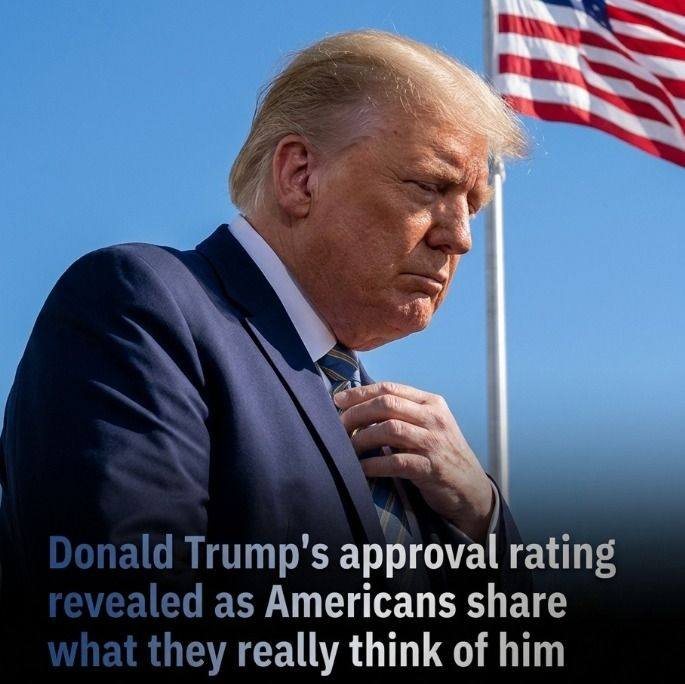
Trump’s second-term polling paints a picture of a country that no longer shares a common political language.
The numbers themselves tell only part of the story a percentage here, a margin of error there, a demographic breakdown that seems to shift with every new survey. But beneath the data lies something far more revealing: a nation that cannot agree on basic facts, let alone the performance of its leader.
Two Americas, Two Realities
One side sees a president trampling norms and weaponizing power a man who tests the limits of every institution, who turns the justice department into a political tool, who governs as though the rules apply to everyone except himself. For these voters, every headline is another piece of evidence that democracy is fragile, that what has been built over centuries can be undone in years, that the guardrails are bending and may soon break.
The other side sees a champion finally doing what they were promised, no matter the cost. For these voters, Trump’s aggression is not a bug but a feature. They wanted someone who would fight not negotiate, not compromise, not politely ask permission from a system they believe is rigged against them. They see his willingness to shatter norms as courage, his disregard for tradition as refreshing, his enemies’ outrage as proof that he is doing something right.
That gap isn’t just about policy. It’s about identity, reality, and which version of America people believe they’re living in. Two citizens can look at the same news clip, the same tweet, the same Oval Office address, and come away with completely opposite interpretations not because one is smarter or more informed, but because they are filtering reality through entirely different worldviews.
The Fear Beneath the Numbers
What makes this moment so volatile is that even areas of supposed “agreement” are built on fear. Consider the economy. Voters terrified of losing their footing in a brutal economic climate will tolerate chaos if they think it protects their wallets. They may dislike Trump’s tone. They may cringe at his insults. But if they believe he is keeping their jobs safe, their grocery bills manageable, their retirement accounts intact, they will hold their noses and vote for him again.
Others fear the cost to democracy more than any spike in prices. They see Trump as a threat not to their bank accounts but to their rights, their institutions, their children’s future. For these voters, no amount of economic growth justifies what they view as authoritarian behavior. They would rather struggle financially than watch the rule of law crumble.
These two fears economic anxiety and democratic dread are not symmetrical. They cannot be traded off against each other like apples and oranges. They exist in different emotional registers, pull on different values, and mobilize different voters. And as long as both sides feel genuinely terrified of what the other represents, compromise stops feeling noble and starts feeling like surrender.
The Polls Are Quietly Screaming
That’s the real danger the polls are quietly screaming. Look beneath the top-line numbers—the 47 percent approve, the 49 percent disapprove, the margin of error that makes everyone feel vindicated and you see a country that is not just divided but calcified. Voters are not shifting their opinions based on new information. They are seeking out information that confirms their existing opinions.
This is not healthy democracy. This is something closer to trench warfare, where each side hunkers down, fires at the other, and measures progress in inches of ground gained or lost. Compromise, in such an environment, looks like betrayal. Finding common ground looks like weakness. And leaders who reach across the aisle are punished by their own base.
The Role of Media and Social Platforms
The fragmentation of the media landscape has accelerated this process. Thirty years ago, most Americans got their news from the same few sources. Disagreements existed, but they were built on a shared foundation of facts. Today, a Trump supporter and a Trump critic may live in completely different information ecosystems. They watch different channels. Follow different influencers. Read different websites. They are not arguing about interpretations of the same reality; they are living in different realities entirely.
Social media has made this worse. Algorithms designed to maximize engagement push users toward more extreme content. Outrage spreads faster than nuance. A thoughtful analysis of trade policy gets buried while a screaming headline about “them” versus “us” goes viral. Platforms that promised to connect us have instead built walls between us, and we are paying the price.
Hidden Sentiments and Surprising Opinions
The polls also reveal hidden sentiments that defy easy categorization. Some voters who supported Trump in 2016 and 2020 are quietly expressing fatigue. They are tired of the drama, the chaos, the constant crises. They still agree with his policies on many issues. But they wonder if the cost of his leadership the exhaustion, the division, the endless battles is worth paying.
Other voters who never supported Trump are admitting, privately, that they admire certain aspects of his approach. They like that he is not a typical politician. They appreciate that he speaks plainly, even when they disagree with what he says. They find themselves watching his rallies not out of support but out of fascination, unable to look away from a figure who has so thoroughly reshaped American politics.
These hidden sentiments do not show up in standard approval ratings. They are too complex, too contradictory, too human to be captured by a simple yes-or-no question. But they matter. They shape the undercurrents of public opinion, the conversations happening around dinner tables and water coolers, the quiet shifts that eventually become landslides.
The Complexity of Public Perception
The picture that emerges from all this data polls, social media analysis, focus groups, and in-depth interviews is not simple. It is messy, contradictory, and deeply human. Trump remains a figure who inspires fierce loyalty and fierce opposition, often in equal measure. His supporters see him as a warrior. His critics see him as a wrecking ball. And both sides have evidence to support their views.
But the most important finding may be this: Americans are exhausted. The constant fighting, the endless outrage cycles, the sense that every election is a battle for the soul of the country it is taking a toll. Voters on both sides report feeling anxious, burned out, and disconnected from neighbors who used to feel like fellow citizens.
A Nation at a Crossroads
As Trump’s second term unfolds, the country stands at a crossroads. The path forward is not clear. Will the divisions heal, or will they deepen? Will Americans find a way to disagree without demonizing each other, or will the trench warfare continue indefinitely? Will the polls eventually show convergence, or will they continue to scream the same warning: that we are living in two Americas, and neither side knows how to find its way back?
The answers to those questions will not come from polls alone. They will come from the choices Americans make every day how they talk to each other, what they believe, who they trust, and what version of the country they are willing to fight for. The data can describe the problem, but only the people can solve it.