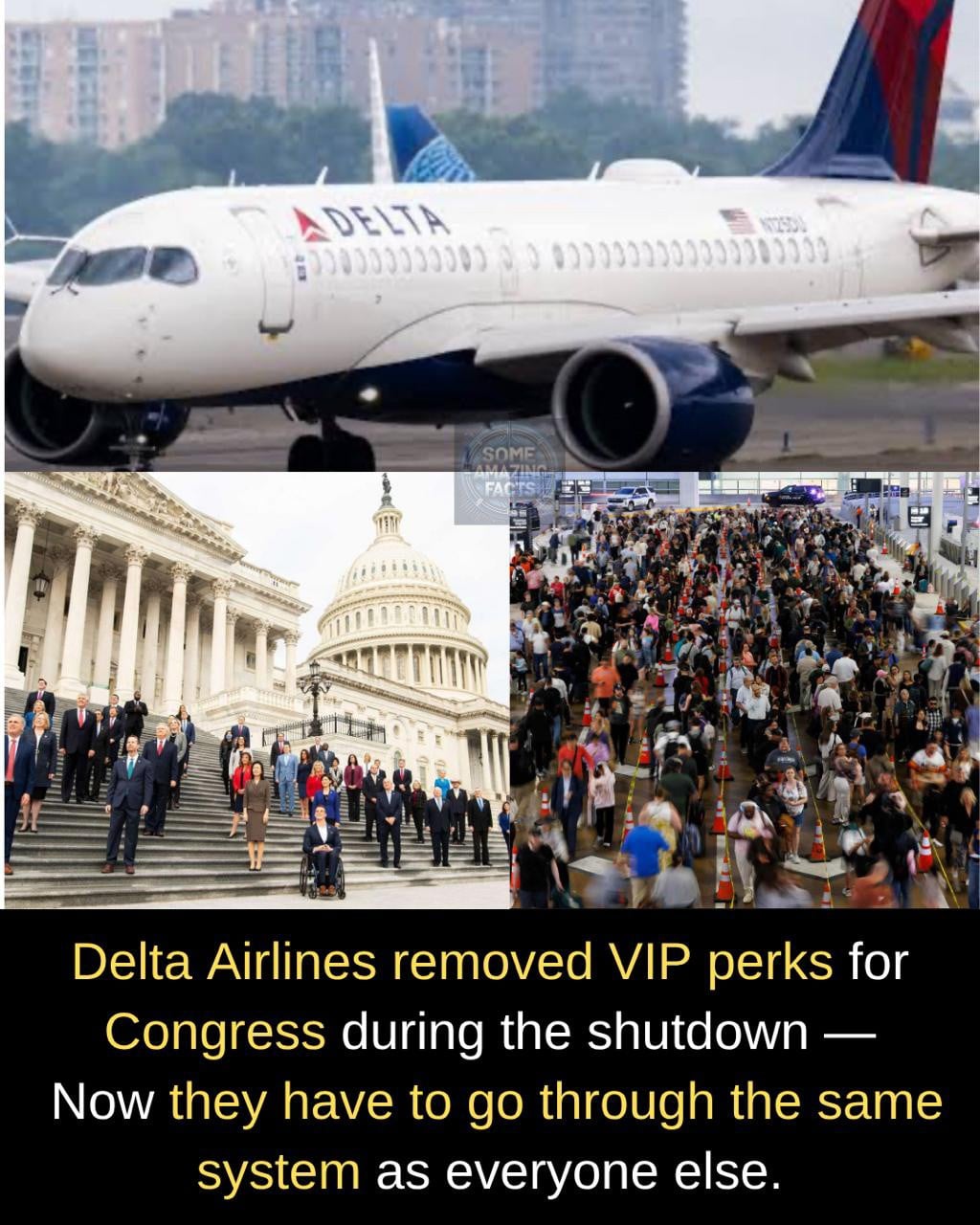
During the shutdown, airport security never fully broke, but it flexed to its breaking point. Across the country, travelers stood in snaking lines that seemed to stretch longer each day.
Patience wore thin. Voices grew tense. The usual rhythm of air travel hurried but predictable gave way to something slower, heavier, and far more uncertain.
TSA officers kept showing up without paychecks. Day after day, they reported for duty not knowing when their next salary would arrive. They parked their cars, walked through employee entrances, and took their positions at scanners and bag checks, all while bills piled up at home. Some worked double shifts. Others picked up extra hours despite exhaustion. The system held together not because of generous funding or efficient management, but because ordinary workers refused to walk away. They chose duty over convenience. They chose responsibility over protest.
The Strain Becomes Visible
Passengers felt it in every extra minute of waiting. What used to take twenty minutes now took forty. What used to take forty stretched to an hour or more. The delays compounded. Missed connections became common. Families with small children struggled to stay calm. Business travelers checked their watches and did the math, realizing they would arrive late to meetings they could not afford to miss.
The strain was visible on the faces of TSA officers as well. They moved more slowly, not from laziness but from fatigue. Their eyes showed the weight of working without financial security. Some tried to smile and make small talk. Others remained silent, conserving energy for the tasks that mattered. The usual banter between agents and travelers faded. In its place was a quiet, mutual understanding: everyone here was doing their best under circumstances no one had chosen.
Yet the system held barely, and only because ordinary workers refused to walk away. They showed up for the public even when the public’s leaders had failed to show up for them. That quiet heroism went largely unremarked in the news, but every traveler who passed through security that week owed them a debt of gratitude.
A Privilege Disappears
Then Delta removed the quiet cushion that had protected lawmakers from that reality. For years, members of Congress had enjoyed a subtle but significant perk: expedited access through airport security. Escorts. Backdoor shortcuts. VIP treatment that shaved minutes off their travel time and spared them the indignity of standing in long lines alongside the very people they represented.
No more. When the shutdown stretched on, Delta made a decision. Officially, it was a resource issue. The airline claimed it could no longer justify assigning personnel to escort lawmakers through security when every available employee was needed to keep operations running. Unofficially, those watching from the outside saw something else: a quiet leveling of the playing field. A reminder that when the system is strained, privilege is often the first thing to go.
Same Lines, Same Uncertainty
Suddenly, lawmakers found themselves doing what ordinary citizens had been doing all along. They waited in the same lines. They took off their shoes and belts. They pulled laptops from bags and placed liquids in small bins. They shuffled forward a few feet at a time, watching the clock, wondering whether they would make their flights.
For some, the experience was humbling. For others, it was merely annoying. But for the travelers standing next to them the teachers, the nurses, the small business owners the moment carried symbolic weight. The distance between power and the public narrowed, not through speeches or reforms, but through shared inconvenience. The people who design the system were forced to stand inside it.
Uncomfortable Clarity
In that rare moment, something shifted. Lawmakers who had voted on budgets and debated shutdown strategies now experienced the consequences firsthand. They could no longer ignore the tired TSA officers working without pay. They could no longer dismiss the frustration of delayed families. They stood elbow to elbow with constituents, both of them watching the same slow-moving line, both of them subject to the same broken rhythm.
The discomfort was not lost on observers. Photographs of lawmakers waiting in regular security lines circulated online. Commenters noted the irony with sharp, sometimes sarcastic, glee. “Welcome to the real world,” one wrote. “Funny how fast perks disappear when the system actually breaks,” said another.
A Lesson in Empathy
For a brief window, the shutdown forced a kind of accidental empathy. Lawmakers who had insulated themselves from the consequences of their own political decisions found those consequences unavoidable. They could not be escorted past the problem. They could not skip the line. They had to live, however temporarily, in the same reality as everyone else.
Whether that experience changed any votes or shifted any positions remains unclear. Political dynamics are rarely transformed by a single inconvenience. But for the citizens who watched lawmakers stand in those lines, the moment mattered. It was a reminder that privilege is often invisible to those who possess it—and that the best way to understand a problem is to be subjected to it yourself.
The System’s Fragile Balance
The shutdown eventually ended. Paychecks resumed. Airport lines returned to their normal length. And Delta, presumably, restored the VIP treatment that lawmakers had come to expect. The quiet cushion slipped back into place, and the distance between power and the public widened once more.
But for those who remember those weeks, the image lingers: lawmakers in regular lines, TSA officers working without pay, and a system held together by ordinary people who refused to quit. The moment did not change the world. But it offered an uncomfortable clarity that, for a short time, no one could escape.
What Remains
In the end, the story of lawmakers forced into regular airport lines is not just about inconvenience or politics. It is about the invisible structures that protect power from the realities of everyday life. It is about the workers who keep those structures running even when they themselves are struggling. And it is about the rare, revealing moments when the distance collapses when those who make the rules must live by them, and when shared struggle becomes, however briefly, a kind of shared truth.
The shutdown exposed many failures. But it also revealed something worth remembering: the people who serve the public often do so without thanks, without security, and without the privileges that make service easier. And when those privileges are stripped away, even for a moment, the system looks less like a machine and more like a fragile web of human effort, holding on by sheer will.