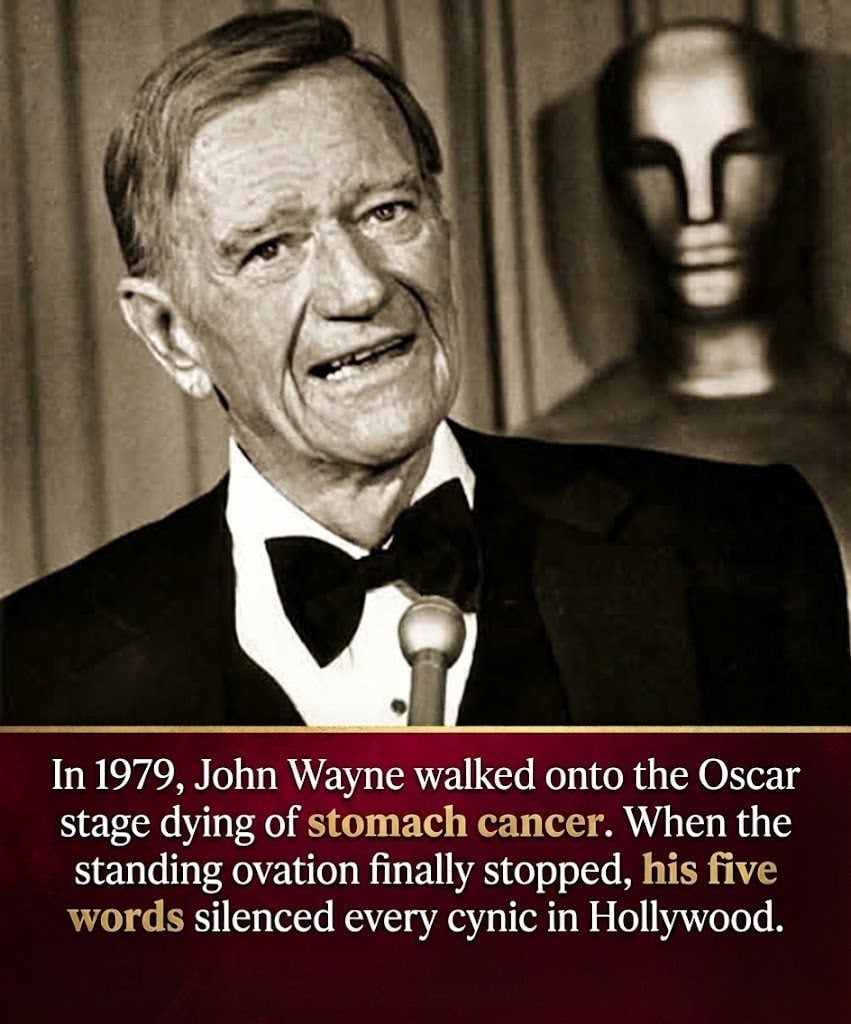
They didn’t just see a legend that night they saw the cost of becoming one. On April 9, 1979, at the Dorothy Chandler Pavilion in Los Angeles, the annual Academy Awards ceremony was already well underway.
The usual glamour filled the room: sparkling gowns, polished tuxedos, nervous smiles, and the quiet hum of anticipation that accompanies Hollywood’s biggest night. But something felt different. There was an unspoken awareness in the air, a collective understanding that the audience was about to witness something more significant than another award being handed out.
The Man Behind the Myth
John Wayne stepped onto that Oscar stage carrying every gunfight, every cavalry charge, every stubborn close-up that had defined American masculinity for five decades. From Stagecoach in 1939 to True Grit in 1969, from The Searchers to Rio Bravo, Wayne had built an entire mythology out of grit, silence, and unshakable resolve. He was the man who never backed down, who faced down outlaws and Indians and bad weather with the same squint-eyed determination. He was the Duke an icon so large that his name alone conjured images of wide-open plains, dusty trails, and justice delivered at high noon.
But the man beneath the myth had been cut open, rebuilt, and left with scars no camera could frame. By 1979, Wayne was fighting the battle of his life. He had undergone major surgery to remove a cancerous lung just months earlier. The procedure had left him weakened, thinner, and visibly fragile. The audience knew this. The world knew this. And yet, when he appeared at the podium, leaning slightly on the arm of a stagehand, the room rose to its feet as one.
An Ovation That Shook the Room
The applause did not fade quickly. It swelled, echoed, and seemed to stretch across decades. Actors who had competed against him, directors who had worked with him, and young stars who had grown up watching him all of them clapped, some with tears already forming. It was not a polite, obligatory ovation. It was a grateful one. A heartfelt one. A recognition that they were witnessing the final chapter of a life that had shaped their industry and their imaginations.
Wayne stood there, absorbing the sound. He had heard crowds cheer before. He had ridden off into countless sunsets, both on screen and in real life. But this was different. This was not a movie premiere or a publicity event. This was real. And for a man who had spent his career pretending to be invincible, the vulnerability of the moment was overwhelming.
The Five Words That Defined Everything
When the applause finally began to settle, Wayne lifted his hand slightly. The room fell into a hush so deep you could hear the rustle of fabric and the distant click of cameras. Then he spoke.
“The only medicine I need.”
Five words. Simple. Unadorned. No grand speech. No theatrical farewell. Just a quiet acknowledgment that the love of the audience the decades of loyalty, the standing ovation, the collective embrace of an industry he had helped build was more powerful than any treatment or surgery.
But here is what made those words land with such force: they weren’t just gracious. They were devastatingly honest. When he called their ovation “the only medicine” he needed, it wasn’t a line. It wasn’t a rehearsed bit of Hollywood charm. It was a confession from a man who knew, deep in his bones, that real healing was no longer possible. The cancer was aggressive. The treatments had taken their toll. And Wayne, ever the realist beneath the bravado, understood that no amount of applause could reverse what was happening inside his body.
Vulnerability Hidden in Plain Sight
What made that moment unforgettable wasn’t his strength alone, but his vulnerability. The Duke, who had outdrawn every villain on screen from Jack Palance’s gunman in Shane to the outlaws in True Grit could not outshoot time. He could not draw faster than mortality. He could not squint his way out of this final confrontation.
Yet he showed up anyway. Not as an untouchable hero descending from some mythical mountain, but as a wounded one thin, pale, leaning on others for support, his voice softer than anyone remembered. He did not hide. He did not send a representative. He did not issue a written statement. He stood there, in front of the entire world, and let them see him as he really was: a man fighting his last fight.
Courage Redefined
In doing so, he turned a farewell into something larger. He redefined courage not as invincibility, but as the willingness to be seen when you are at your weakest. He proved that bravery isn’t never falling it’s standing up when everyone knows you’re hurting, and walking into the light one last time, even when every step costs you something.
The audience that night did not just applaud John Wayne the actor. They honored John Wayne the human being. They thanked him for the decades of entertainment, yes. But more than that, they thanked him for showing them, in his final public appearance, what it truly looks like to face the end with dignity, grace, and an almost unbearable honesty.
The Legacy of That Night
John Wayne passed away just two months later, on June 11, 1979. The world mourned. Flags flew at half-mast. Fans left flowers and letters at his grave. But for those who were in that auditorium or watching on television the farewell had already happened. They had already said goodbye, not with speeches or eulogies, but with applause that doubled as a prayer, and with five words that still echo across the decades.
To this day, film historians and fans return to that moment. Clips of Wayne’s brief appearance circulate online, shared by new generations discovering his work for the first time. And every time, the comments fill with the same reactions: tears, gratitude, and a quiet sense of having witnessed something sacred.
Why It Still Matters
Why does that moment continue to resonate, more than forty years later? Because it strips away the illusion that heroes are supposed to be untouchable. It reminds us that the people we admire the actors, the athletes, the leaders are just as fragile as we are. They hurt. They fear. They face the same endings we all face. And sometimes, in their most vulnerable moments, they teach us more about living than they ever did in their strongest performances.
John Wayne’s five words were not a performance. They were not scripted. They were not edited for maximum emotional impact. They were simply true. And in a town built on artifice and illusion, that truth landed like a thunderclap.
The Final Frame
So when the lights dimmed at the Dorothy Chandler Pavilion on April 9, 1979, Hollywood held its breath. And when John Wayne spoke, the world exhaled not in relief, but in reverence. Because in five simple words, he had done something no film could ever capture: he had shown millions of people how to face the fading light with their head held high, their heart still beating, and their voice still strong enough to say thank you.
And that, perhaps, is the most unforgettable role he ever played.