On a cold January morning in Minneapolis, 37-year-old Renee Nicole Good— a mother of three known for her involvement in her neighborhood—began the day unaware it would end in tragedy.
According to authorities, Good was approached by Immigration and Customs Enforcement (ICE) officers during what was described as a routine enforcement action. Officials later said the situation escalated when she attempted to leave the scene in her vehicle.
Video footage that later circulated online appears to show Good’s car moving in the direction of an ICE agent. Moments later, the officer fired his weapon, killing her.
Law enforcement officials initially stated that the agent believed he faced an immediate threat. Still, the shooting quickly ignited intense public reaction, prompting protests, media scrutiny, and national debate over immigration enforcement and the use of lethal force.
Those who knew Good described her as a devoted parent, cautious by nature, and deeply committed to her children. Her death sent shockwaves through her community, where neighbors remembered her as kind, attentive, and engaged.

As news spread, social media amplified her story, transforming a local tragedy into a national flashpoint—one that highlighted broader concerns about federal enforcement practices and their human consequences.
A Nation Divided
The incident quickly became a focal point of political and cultural division.
Supporters of Good pointed to longstanding concerns about racial disparities in law enforcement, arguing that communities of color bear a disproportionate burden of aggressive policing and immigration actions.
Others defended the ICE agent, emphasizing the unpredictable and often dangerous conditions officers face in the field. Advocates for law enforcement noted that split-second decisions can determine survival and argued that agents are trained to respond decisively when they perceive a threat.
In Minneapolis, demonstrations followed—some peaceful, others tense. Across the country, elected officials, activists, and commentators weighed in, often reinforcing existing ideological divides.
The debate underscored a recurring national tension: how to enforce federal law while maintaining accountability, transparency, and public trust.
Bill Ackman’s Donation Sparks Controversy
Amid the escalating debate, billionaire investor Bill Ackman entered the conversation.
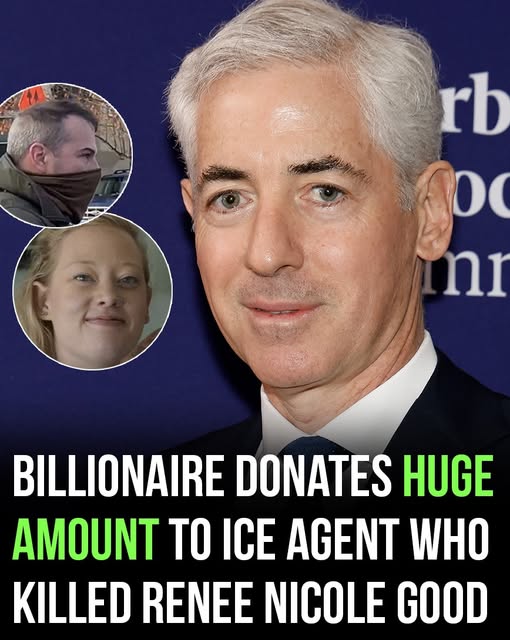
Ackman donated $10,000 to a GoFundMe campaign established to support Jonathan Ross, the ICE agent involved in the shooting. Ackman stated publicly that his contribution was rooted in support for due process, emphasizing that individuals are presumed innocent until investigations conclude.
He also noted that he had initially intended to donate to a fundraiser for Renee Good’s family but discovered that campaign had already exceeded its fundraising goal and closed.
The donation quickly became controversial.

Supporters argued Ackman was defending a foundational legal principle rather than endorsing violence. Critics countered that the contribution symbolized support for a system they believe too often excuses lethal force against marginalized individuals.
The episode highlighted how actions by high-profile figures can carry symbolic weight far beyond their stated intent—especially during emotionally charged events.
Two Fundraisers, Two Narratives
At the same time, a separate fundraising campaign for Good’s family raised more than $1.5 million from tens of thousands of donors. Contributors emphasized her role as a mother and community member, framing the effort as collective mourning and mutual aid.
The agent’s fundraiser drew scrutiny for its language and purpose, with some critics questioning whether such campaigns align with platform policies when tied to fatal incidents.
Legal experts noted that raising funds for legal defense is generally permissible, but public perception can complicate matters—particularly when investigations are ongoing.
The contrast between the two fundraisers became symbolic: one centered on loss and remembrance, the other on legal protection and officer safety.
Media, Social Platforms, and Competing Narratives
Traditional news outlets focused on verified details—body camera footage, official statements, and the agent’s background. Meanwhile, social media accelerated emotional responses, often blending fact, interpretation, and speculation.
Short video clips circulated widely, accompanied by captions that framed the event through sharply different lenses. Some emphasized the moment the vehicle moved forward; others focused on Good’s identity and family.
Experts note that in such cases, public understanding is shaped as much by emotional framing as by factual reporting.
Broader Context and Longstanding Questions
The shooting renewed attention to systemic issues surrounding immigration enforcement and federal use-of-force policies.
Reform advocates pointed to historical patterns showing disproportionate impacts on marginalized communities and called for stronger oversight, clearer protocols, and enhanced de-escalation training.
Defenders of ICE emphasized the agency’s mandate to enforce federal law under difficult conditions, often involving individuals whose actions can change rapidly.
The Minneapolis incident became a case study in the challenges of balancing operational necessity with ethical responsibility.
Political responses followed predictable lines. Conservative leaders focused on officer safety and warned against hindsight judgment. Progressive lawmakers and advocacy groups called for independent investigations and structural reform.
Due Process and Public Accountability
At the center of the controversy lies a fundamental legal tension.
Law enforcement officers are entitled to due process, including the presumption of innocence. At the same time, the public demands transparency and accountability when deadly force is used.
Crowdfunded legal defense efforts, while lawful, raise questions about narrative framing—particularly when they emerge before investigations conclude.
Legal analysts stress the importance of separating financial support for legal rights from premature judgments about culpability.
Community Impact and Healing
Beyond national politics, the consequences were deeply local.
Minneapolis residents organized vigils, forums, and counseling initiatives. Schools and community organizations mobilized to support Good’s children, who now face life without their mother.
Community leaders emphasized dialogue, grief support, and nonviolent engagement, seeking healing amid anger and sorrow.
Ethics, Power, and Public Influence
Ackman’s donation reignited discussion about the role of wealthy individuals in public controversies. While philanthropy can support legal principles, it can also shape public narratives—intentionally or not.
Some saw his action as principled. Others viewed it as reinforcing unequal power dynamics within the justice system.
The divergence in interpretation reflects broader societal questions about influence, fairness, and accountability.
Looking Ahead
The incident is likely to influence future discussions around federal law enforcement, immigration policy, and use-of-force standards.
Lawmakers may revisit oversight mechanisms, training requirements, and transparency measures. Analysts suggest sustained civic engagement will play a key role in shaping reform.
For many, Renee Good’s story remains central. Memorial efforts continue in her name, ensuring that policy debates remain grounded in human reality.
Her life—and death—serve as a reminder that behind every headline lies a family, a community, and consequences that extend far beyond the news cycle.
Final Reflection
The Minneapolis shooting, the dueling fundraising efforts, and Bill Ackman’s involvement collectively illustrate the complexity of justice in modern America.
They highlight how legal principles, public perception, philanthropy, and grief intersect—often uncomfortably—in moments of national attention.
Ultimately, the case underscores a shared responsibility: to seek accountability without abandoning fairness, and to remember that policy debates are inseparable from the lives they affect.