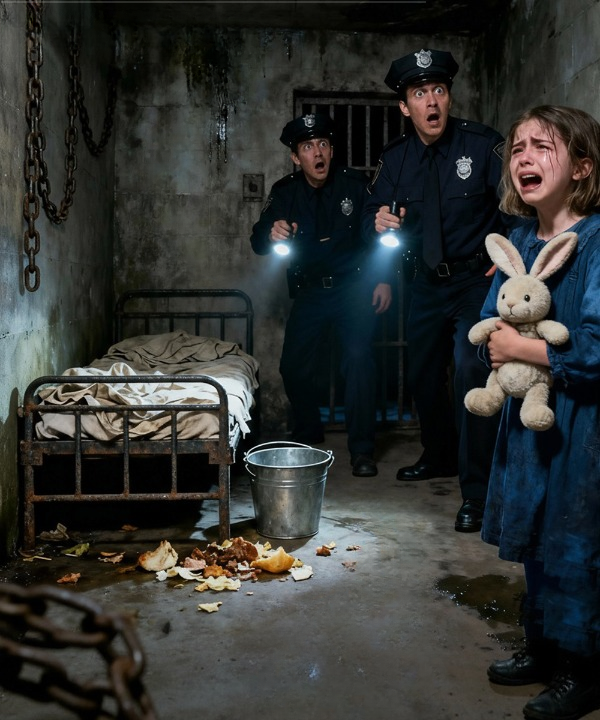
It was a quiet night in the suburban enclave of Maplewood, New Jersey. Beneath a soft breeze and the hush of darkness, most families were settling into sleep. But inside the local police station, the stillness was shattered by a trembling voice over the emergency line — a call that would soon rock the community.
“My name is Emily Carter,” the child sobbed. “I’m ten years old. Please… I don’t want to sleep in the basement anymore. Can you send someone?”
Angela Mills, the dispatcher, had handled hundreds of calls. But this one was different: raw, urgent, laden with fear. She sensed it needed immediate response. “Emily, sweetheart, you did the right thing calling,” she coaxed. “Can you tell me your address?”
After a few seconds of silence, Emily whispered the street and house number on Oak Street. Angela sprang into action, dispatching Officers Daniel Hayes and Laura Bennett without hesitation.
A House That Looks Too Perfect
When Hayes and Bennett arrived, nothing about the house seemed alarming at first glance. A well-kept lawn, a glowing porch light, a car parked neatly in the driveway — the picture of suburban normalcy. Still, as they approached, a weight seemed to hang in the air, as if the house itself was holding a secret.
Robert Carter, Emily’s stepfather, answered the door. He was polite, measured, cautious. “Officers, good evening,” he said with a forced calm. “Is there a problem?”
Officer Bennett spoke gently: “Emily called us. She said she needs help.”
Robert’s composure flickered. He insisted she was asleep, that perhaps the call was a mistake. But Hayes pressed on. “Sir, we need to check,” he said.
As they entered, the interior was pristine. Family photos lined the hallways, showing happy faces: Robert, his wife Melissa, and a young Emily smiling together. Yet, something tugged at Officer Hayes’s instincts. In every photo, Emily looked much younger than ten — more like six or seven. That inconsistency weighed on him silently.
They called Emily’s name. No reply. Then Hayes’s eyes landed on a door at the rear of the home — locked, ominous.
“What’s in there?” he asked Robert.
“Just storage,” Robert replied, voice taut.
But Hayes didn’t wait. He forced the door open, and the truth spilled out.
In the Darkness Below
Descending into the basement, they found a cold, damp room lit by a single, dim bulb. The walls were cracked, the air stale. In one corner crouched a small girl, knees pulled to her chest, shaking and alone.
As the officers called out and stepped closer, the child bolted. She ran to Officer Bennett, wrapping trembling arms around her waist. “Please don’t make me stay down here anymore,” she whispered through her tears.
That moment crystallized what they already suspected: Emily had been hidden away, silenced, neglected.
Instantly, the officers escorted her to safety upstairs while radioing for backup and contacting Child Protective Services.
The Investigation Unfolds
In the days that followed, the cracks in the Carter family façade grew wide open. School records showed Emily had not attended classes in months. Neighbors revealed that they rarely saw the girl outside or playing. Friends and acquaintances reported odd rumors — a home of eerie quiet, a family not quite what they appeared.
When questioned, Robert Carter became defensive; Melissa spoke in hushed, evasive tones. Under pressure, the truth emerged: Emily had lived in seclusion, deprived of education, freedom, and dignity.
Charges were swiftly filed: unlawful confinement, neglect, child endangerment, and other related counts. The court prepared for a trial that would demand courage from a young girl and the community alike.
The Courtroom and Beyond
Inside the courtroom months later, Emily — no longer a hidden whisper — testified. Her words were quiet but powerful: “I just wanted to go to school. I wanted to be like the other kids.” Supported by officers and a guardian, she faced the room with strength uncommon for someone so young.
The court found Robert and Melissa Carter guilty on multiple counts. Sentences were handed down to ensure Emily would never return to that environment.
Emily was placed with a caring foster family, the Harrisons, who provided stability and love. She returned to school, found friends, and gradually reclaimed her childhood. She discovered solace in art and creativity, using drawing and painting to tell what words often couldn’t.
Officer Bennett stayed connected, checking in, cheering her on, reminding her she was not alone.
A Community Changed
Emily’s case sparked a transformation in Maplewood. What had seemed like an isolated tragedy became a wake-up call. Schools ramped up child welfare outreach. Neighbors pledged to be more vigilant. Law enforcement and social services strengthened protocols, ensuring no child’s cry would ever be ignored again.
Emily Carter became more than a survivor — she became a symbol of courage and the power of a voice, however small, to change everything.
Years later, Emily spoke to a local news outlet:
“Asking for help was the bravest thing I ever did,” she said. “That phone call saved my life.”
In Maplewood, her name became shorthand for vigilance, compassion, and the idea that every child deserves to be seen, heard, and protected.
In the end, the little girl who once hid in a basement became the spark that turned a sleeping town toward waking up — toward caring, response, and change.