When the military said Corporal Danny Chen’s body would arrive “when the weather allows,” 47 bikers took matters into their own hands.
Danny, a U.S. Marine, had been killed in combat overseas. His final wish was to be laid to rest in his hometown of Millfield, Montana — beside his father, who had died in a motorcycle crash when Danny was twelve.
Severe winter storms had halted military transport indefinitely. Danny’s mother, Sarah, received a cold, automated message: her son’s remains would be delayed two to four weeks — “weather dependent.”
Heartbroken, she wrote a post in a Gold Star Mothers Facebook group at 2 a.m., saying, “All I want is for my boy to be home for Christmas.”
By 8 a.m., help was on the way.
Within six hours, Rolling Thunder, a veteran biker organization, had pulled together 47 riders from six states. Their mission: ride to the military base, collect Danny’s casket in a custom motorcycle hearse, and escort him 1,200 miles through some of the worst blizzard conditions in decades.
When they arrived at Fort Carson, Colorado, base officials were stunned.
“With all due respect, you’re asking for a suicide mission,” the commander said. “These roads are impassable. We’ve got whiteouts, black ice—entire mountain passes shut down.”
Big Jake, a 67-year-old Vietnam vet and president of the Montana chapter, just nodded, his gray beard frozen from the ride down.
“He rode into hell for this country,” he said. “We can ride through a little snow to get him home.”
Behind him stood 46 riders, veterans of Vietnam, Iraq, Afghanistan, Desert Storm — their breath fogging in the cold, snow piling on leather jackets, engines still ticking from the road.
The base commander shook his head. “I can’t approve this.”
“Didn’t ask for approval,” Jake replied. “Just need our Marine.”
Three Days. Two States. One Mission.
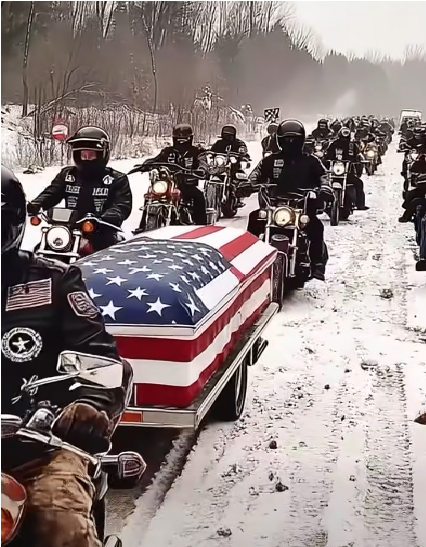
They departed Fort Carson at noon with Danny’s casket secured in a specially designed motorcycle hearse — a sidecar rig outfitted with stabilizers, protective panels, and an American flag draped inside.
It was 18 degrees. Wind chill below zero. Snow so thick you couldn’t see more than 20 feet ahead.
“Ride tight, stay alert,” Jake said into his comms. “No heroes.”
Every 50 miles, the riders rotated positions to avoid frostbite. At each gas stop, they checked each other for signs of exposure, forced down hot coffee, and pushed forward.
In Wyoming, state troopers tried to turn them back.
“Roads are closed. You’ll have to wait.”
“Sorry, officer,” Jake replied. “We’ve got a Marine to deliver.”
The trooper glanced at the flag-covered casket, nodded, and said: “Follow me.”
He cleared a path for them. Others joined. Soon, the caravan had full police escort.
A Country Watches
News crews caught wind of the mission. Reporters at rest stops interviewed riders.
“Why are you risking your lives for this?”
“Because he risked his for us,” said Tommy, 74, a Vietnam vet with frostbitten hands from Hanoi. “We owe him that.”
The convoy stopped at a truck stop near Casper. The owner, upon learning their story, covered everyone’s food and coffee.
“My grandson’s deployed right now,” she said, eyes full of tears. “Bring that Marine home.”
Truckers stood in silence as the bikes rolled out, hands on hearts.
When the Worst Hit, So Did Help
The second day was brutal. Visibility hit near zero. Three riders slid out on black ice but got back up.
Then the hearse trailer skidded. They stopped to secure it.
That’s when an old pickup pulled over.
“You boys hauling a soldier?” the rancher asked.
“Marine,” Jake answered. “Taking him home.”
The man nodded. “My son never made it back from ’Nam.” He pulled out his phone. “Give me ten minutes.”
Within the hour, 12 trucks with chains arrived — veterans, locals, families. They boxed in the riders, forming a moving barricade to break wind and clear a path.
“We’ll keep you safe,” the rancher said. “You just get him home.”
A Hero’s Welcome
At dawn on day three, the group reached Millfield.
The entire town had gathered.
Flags lined the streets. The high school band played in the snow. Veterans stood at attention. And waiting at the end of Main Street was Sarah.
Jake stepped off his bike and approached.
“Ma’am,” he said softly. “We brought your boy home.”
She fell into his arms, sobbing.
They formed an honor guard as Danny was moved to the local funeral home. But before the hearse pulled away, Sarah asked to touch the bike that had carried her son.
She placed a hand on the frozen metal and whispered something no one else could hear.
Later, she told Jake:
“I said his dad would be proud. That he was brought home by the same kind of men who raised him — the kind who show up.”
The Legacy
Danny was buried next to his father on Christmas Eve. All 47 bikers stood graveside as Taps played, their breath misting in the freezing air.
Before the casket was lowered, Jake placed something on top: a worn leather vest — the one Danny’s father had worn. The one Sarah gave Jake that morning.
“He should have it now,” she said. “So he can ride with his dad.”
As the casket descended, 47 engines roared to life — not just noise, but a final salute.
More Than a Ride
The story made national headlines. Donations poured in. Sarah used them to launch the Danny Chen Memorial Fund, supporting the return of fallen service members when official routes fail.
Public perception of motorcycle clubs shifted. The world saw what bikers had always known: brotherhood doesn’t end with war. It rides on.
Jake never sought fame. But he framed one letter, now hanging in his garage:
“You didn’t know my son. You didn’t owe us anything. But you showed up, because real heroes do. Danny wanted to ride. You made sure he did — surrounded by 47 angels in leather. Thank you. – Sarah Chen”
One Year Later
On the anniversary, 47 riders returned. They laid roses between the two graves. Then they rode to Sarah’s house, where she’d cooked for all of them.
Jake handed her a vest:
“You’re Rolling Thunder now. Family doesn’t end in blood.”
She wore it proudly. That spring, Sarah learned to ride — on her late husband’s Harley, the same one her son had dreamed of riding someday.
And every Christmas Eve, 47 bikes rumble into Millfield.
They stand in the snow and remember a Marine, his father, and the ride that proved this truth:
When bureaucracy says “wait,” and common sense says “don’t,”
bikers say “watch us.”
They ride.
They deliver.
And they never leave a brother behind.
Not in war. Not in blizzards.
Not ever.